SC - Lezione 17
Checklist
Domande, Keyword e Vocabulary
- Conjugate Gradient
- symmetric matrix
- when it is better to use Conjugate Gradient respect to Gauss or LU?
- quadratic function
- Real world applications of minimization
- Nonlinear Least Squares exponential fitting
- Fitting of a nonlinear model
- Maximization of the likelihood
- Parameters of the gaussian distribution /normal function
- What is the Likelihood?
- Logistic Regression
- What is the Sigmoid Logistic Function??
- Medical dataset example
- Logistic Regression
- Binary classifier
- Bernoulli Probability
- Log-Likelihood
- Admission status - student exam scores example
- Robotic Arm
Appunti SC - Lezione 17
Conjugate Gradient

(in green the optimal step size, in red the conjugate vector)
What it is used for
To solve a linear system
As conseguence of the symmetry, the matrix S is positive definite, means that all its eigenvalues are positive numbers.
Approximation
Unlike Gauss Method and LU Factorization methods which are direct methods for linear systems, CG generates a sequence of
Gauss Method vs LU method vs Conjugate Gradient
Question: when it is better to use Conjugate Gradient respect to Gauss or LU?
Answer:
When the matrix is very large and sparse. Because, in order to compute each approximation, it will do a couple of matrix-vector multipication. If
So, the conjugate matrix can be very effective in this case. The very fast convergence of the conjugate gradient comes from this:
Quadratic Function
Consider the quadratic function:
then
Therefore we can solve the problem of finding the minimum x of f(x) by solving the linear system
S-conjugate-norm of a vector
If you take any vector, you can define a new norm that depends on the matrix S, called S norm such that:
Initial approximation and residual
is the scaled directional derivative of
Second residual
Alternative quadratic functions
We saw that CG can minimize quadratic functions of the form:
But it also works on more general quadratic functions of the form:
where the
Since
Second Derivative
The second derivative of the quadratic function
Why it is efficient
The CG method works well for minimization because it doesn’t merely follow the steepest gradient at each step (as in regular gradient descent). Instead, it uses a sequence of directions that are conjugate to each other relative to
The sequence of conjugate directions
Real-World Applications of Minimization
Nonlinear Least Squares: exponential fitting
The problem
Minimization problem in which we are given a set of nodes
We want to solve the problem in the Least Square sense, that is:
The true parameters of the vectors are the one of the unperturbed model.
I want to minimize the 2 norm of this function that depends from c. We are not really interested in
The true goal of this method is not to compute the exactly true line, the exponential with the true parameters choosen at the beginning (in the example):
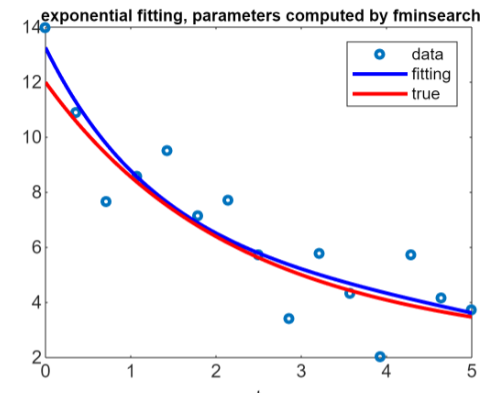
But we want to compute an approximation, a fitting that is the blue line
But we have seen other problem to solve this problem like a gradient descent method:
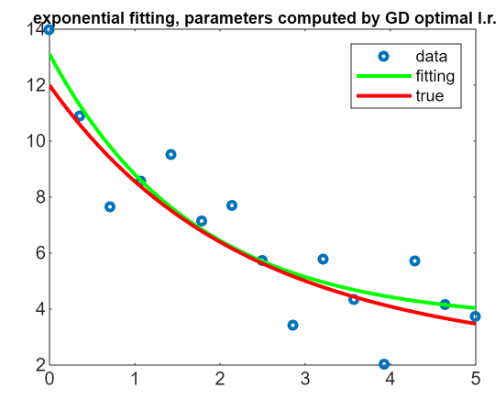 And it also works really really well.
There are also some other matlab functions, one of these is called lsqcurvefit.
Maximization of the likelihood
We want to maximize the likelihood of a dataset
What is the likelihood
The likelihood is a function that measures how well a statistical model explains observed data by calculating the probability of seeing that data under different parameter values of the model.
In our example, we consider a Gaussian distribution, so the likelihood depends on the two parameters: the mean and the variance (
We start with a set of
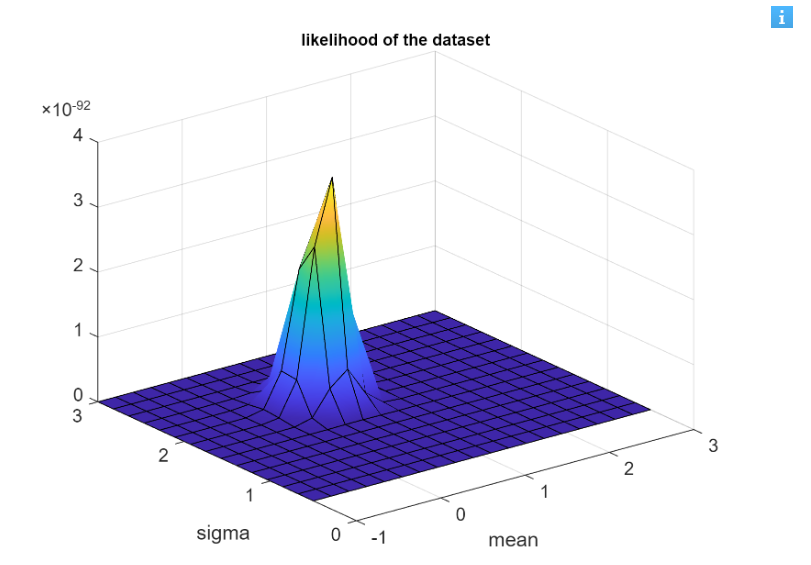 As we can see this graph depends from three variables: sigma that is the variance, mean that is
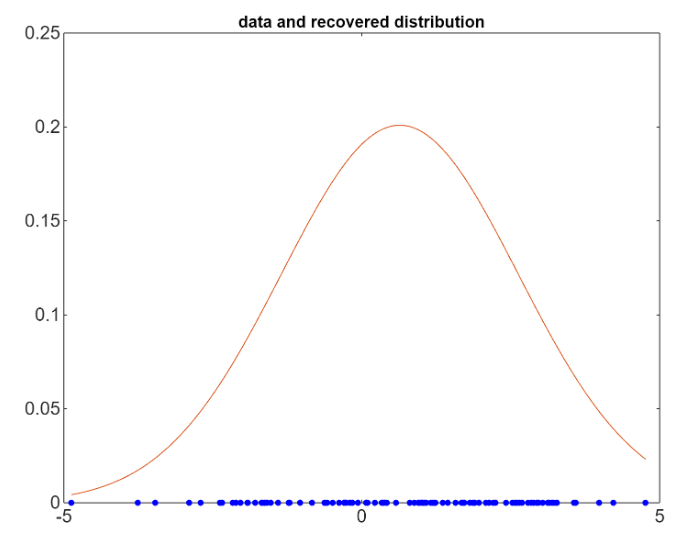 To maximize the likelihood we look for the minimum of the negative of the likelihood function.
Logistic Regression and maximization of likelihood
An application of the maximization of likelihood is the logistic regression, that is an important tool used in binary classification. (backlink a ML)
What is the Sigmoid Logistic Function?
The sigmoid logistic function is a function, usually used often for describing population grows; initially very fast then it arravies at a stable point.

Description of the problem
For instance, consider a medical dataset when you want to classify if a patient has flu or not, and you have set of parameters. We use the logistic regression to classify a new sample (a new patient), that does not belong from the starting dataset.
In general:
Consider a dataset
has a value 1 or 0.
Note: The Logistic Regression is not a regression, even if the name may trick you. It’s a binary classifier.
You maximize the likelihood to compute the parameters of a model.
By maximing the likelihood the training data we compute the parameters
Likelihood definition for this problem
The probability that the model, given a set of parameters, produced the observed results. In our example we can express it as:
As Bernoulli distribution
If we call the set of parameters
Note: i called the set of parameter as B because i think it’s clearer, but it’s not taken from the Matlab.
Why we need the logistic function
The probability distribution in logisitic regression is given by the logistic function, due to its suitable properties for modelling binary outcomes:
Any number (
Moreover, it is common to work with the log-likelihood because it turns the product into a sum, avoiding too small values
Or:
The parameters
Matlab example commented
% load the data (training set)
% data = load('student_data.txt'); % 2 columns for the 2 features, last column for the label
data = [22 21 0; 19 26 0; 28 27 1; 26 26 1; 25 26 1; 20 24 0; 24 24 0; 22 28 0; 27 30 1; 29 27 1]; % 2 columns for the 2 features, last column for the label
X = data(:,1:2); % exam scores
y = data(:,3); % admission status (0=not admitted, 1=admitted)
% set the initial parameter values
b0 = zeros(3, 1);
X_ext  = [ones(size(y)) X]; % add a column of 1 for the parameter b0 (the intercept)
% we use fminsearch to maximize the likelihood (minimize the negative log-likelihood)
bcomp = fminsearch(@(b) logistic_loss(b, X_ext, y), b0);
Imagine we have a dataset of students where the first two numbers represent grades in two main exams. The third value indicates whether the student was admitted to an American university, with 0 meaning “not admitted” and 1 meaning “admitted.” Using this dataset, we can train a logistic regression model to predict whether a new student, based solely on their two exam grades, would be admitted.
This is a simple example, but even with limited data, the model can learn that the grade from the first exam has a stronger impact on admission chances than the grade from the second exam.
Robotic Arm
To do