HPC - Lecture 8 - Matrix by Matrix multiplication with multithreading
Problem:
- A is a matrix with
rows and columns - B is a matrix with
rows and columns - C is a matrix with
rows and columns
It can be observed that each element
- with
In a shared memory MIMD environment (e.g. multicore CPU) it is possible to assign the calculation of each
Algorithm 1
Thread Organization - Algorithm 1
Using NT threads, organized as a grid of
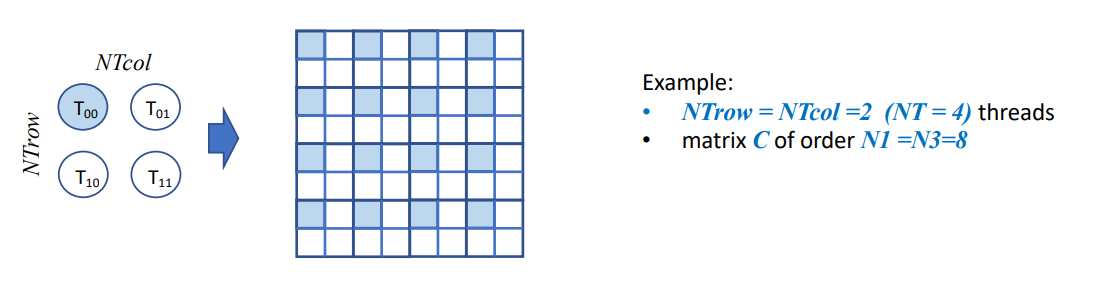
N.B. We assume that
Algorithm 1
- Algorithm executed by each thread according to the SPMD model.
- Threads are identified by a pair of indices (Idi and Idj).
- The iteration structures with indices ii and jj define the number of elements of matrix C computed by each thread.
- Each element
is computed as the dot product (as index varies) of the -th row of A and the -th column of B.
for ii = 0 to N1/Ntrow - 1
    for jj = 0 to N3/Ntcol - 1
        i = Idi + ii * NTrow
        j = Idj + jj * NTcol
        for k = 0 to N2 - 1
            c(i,j) = c(i,j) + a(i,k) * b(k,j)
        endfor
    endfor
endfor
Each thread computes
N.B. For simplicity, we assume
Evaluation of algorithm 1
We use Amdahl’s law to evaluate the possible algorithms (P computing units, i.e. the threads).
Let us recall that:
- Speed-Up:
- Absolute Overhead:
- Relative Overhead:
Execution time with
Speed-up derivation:
Where
Total overhead:
Evaluation of algorithm 1 - Performance analysis
For simplicity, let’s consider square matrices of order
With
- Matrices A and B for reading
- Matrix C for reading and writing.
Remembering that the number of operations is
If
Since each thread has to compute a total of
The overhead is:
From which we derive:
Even in the absence of critical sections, the parallelization of the problem has introduced an overhead that depends on data access. This is because threads must access the same elements of arrays A and B several times, independently of one another, to calculate their own values of C.
Algorithm 2
A second algorithm can be obtained by observing that each row
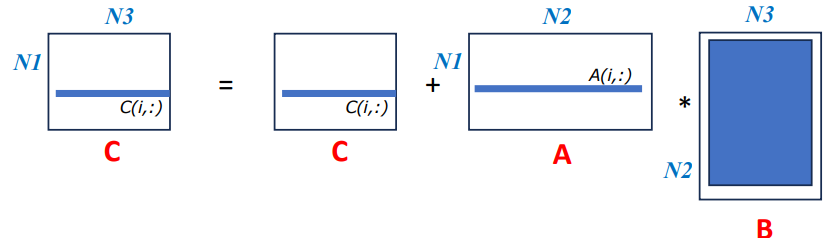
You can assign the calculation of a row
Thread Organization - Algorithm 2
Using NT threads arranged along a linear sequence, each of them is then assigned the task of cyclically computing
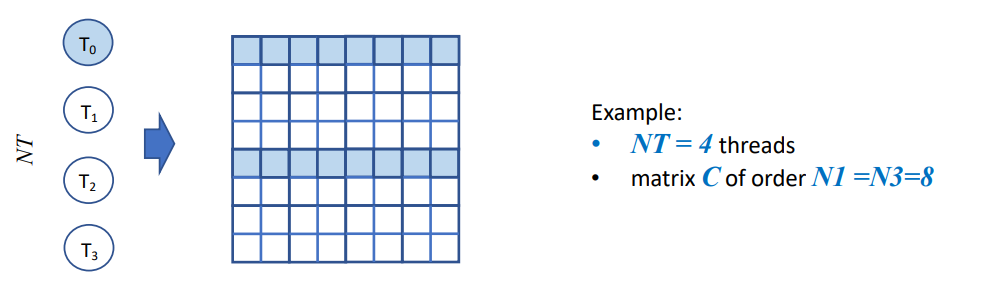
N.B. We assume that
Algorithm 2 (Pseudocode)
- Algorithm executed by each thread according to the SPMD model.
- Threads are identified by an index (ID).
- The iteration structure with index ii defines the rows of matrix C computed by each thread.
- Each row
is computed as the dot product (as indices and varies) of the -th row of A and the entire matrix B.
for ii = 0 to N1/NT - 1
    i = ID + ii * NT
    for j = 0 to N3 - 1
        for k = 0 to N2 - 1
            c(i,j) = c(i,j) + a(i,k) * b(k,j)
        endfor
    endfor
endfor
Each thread computes
Evaluation of algorithm 2
For simplicity, let’s consider square matrices of order
With
- matrices A and B for reading
- matrix C for reading and writing
Remembering that the number of operations is
If
Since each thread has to compute a total of
The overhead is:
From which we derive:
This overhead is lower (about half) than that obtained for Algorithm 1.
Important observations
In the two algorithms presented, the overhead depends on the number of memory accesses. In both cases, the number of memory accesses is:
Assuming there is enough cache memory to hold all the problem data, performing matrix multiplication would require a number of memory accesses:
The two studied algorithms introduce an overhead that is considered too high to achieve reasonable speed-up values.
By dividing matrix C into blocks (to be assigned to different threads) and calculating these blocks as the product of matrices performed between blocks of matrix A and blocks of matrix B, we can benefit from a better ratio between the number of memory accesses and the number of operations performed.
Algorithm 3
Each block of rows
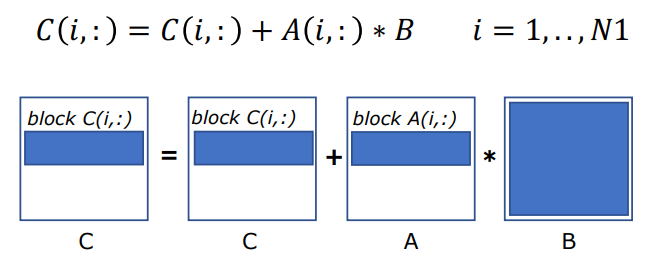
We can assign the block calculation of rows
Thread organization - Algorithm 3
Using NT threads arranged in order along a linear sequence, each of them is assigned the task of computing one block of
N.B. We assume that
Algorithm 3 Pseudocode:
- Algorithm executed by each thread according to the SPMD model.
- Threads are identified by an index (ID). The index of block
is exactly the thread index. - The iteration structure with index i defines the
rows of block computed by the thread with identifier Id. - This block is computed (as indices
vary) as the product of the matrix corresponding to block and the entire matrix B.
for i = ID * N1/NT to (ID + 1) * N1/NT - 1
    for k = 0 to N2 - 1
        for j = 0 to N3 - 1
            c(i,j) = c(i,j) + a(i,k) * b(k,j)
        endfor
    endfor
endfor
Each thread computes 1 matrix-matrix product.
Evaluation of algorithm 3
For square matrices of order
With
- matrices A and B for reading
- matrix C for reading and writing
Remembering that the number of operations is
If
Blocks of matrices A and C have
The overhead for algorithm 3 is:
Since usually
Algorithm 4
Each block 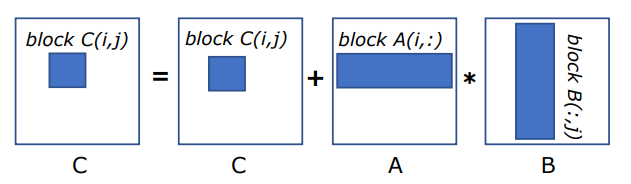
We can assign the block calculation
Thread organization - Algorithm 4
By arranging the NT threads in a way analogous to the blocks of matrix C, Algorithm 4 requires each of them to compute a block of
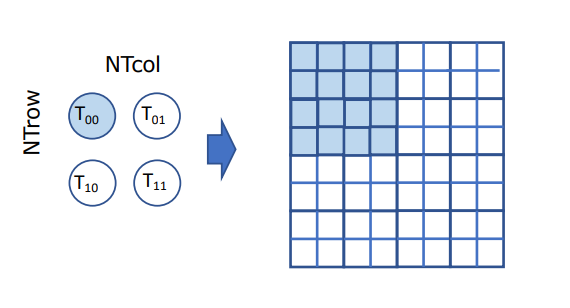
N.B. We assume that
Algorithm 4 (Pseudocode):
- Threads identified by a pair of indices (IDi and IDj). The indices of block
is exactly the thread indices. - Iteration structure with indices i and j defines elements of block
computed by the thread with identifier and . - Block computed (as the indices i,j and k vary) as matrix-matrix product of block
and block .
for i = IDi * N1/NTrow to (IDi + 1) * N1/NTrow - 1
    for k = 0 to N2 - 1
        for j = IDj * N3/NTcol to (IDj + 1) * N3/NTcol - 1
            c(i,j) = c(i,j) + a(i,k) * b(k,j)
        endfor
    endfor
endfor
each thread computes 1 matrix-matrix product.
Evaluation of algorithm 3
For simplicity let’s consider square matrices of order
- matrices A and B for reading.
- matrix C for reading and writing.
Remembering that the number of operations is
If
- The block
, requiring read and write accesses. - The block
, requiring read accesses. - The block
, requiring read accesses.
Execution time:
Overhead:
From which we derive:
The overhead obtained is still lower than that of Algorithm 3.
Algorithm 3 represents a special case of Algorithm 4 where
Part 2: Mat-Mat Product & Multithread: Exercises
Exercise
Implement a multithreaded matrix multiplication version with the following prototype:
void matmatthread (int ldA, int ldB, int ldC, double *A, double *B, double *C,
                   int N1, int N2, int N3, int db1, int db2, int db3,
                   int NTROW, int NTCOL) {
    // ...
}- ldA, ldB, ldC: leading dimensions of the arrays.
- *A, *B, *C: pointers to the matrices.
- N1, N2, N3: matrix dimensions.
- db1, db2, db3: block sizes to be passed to
matmatblock. - NTROW, NTCOL: number of threads in each grid direction.
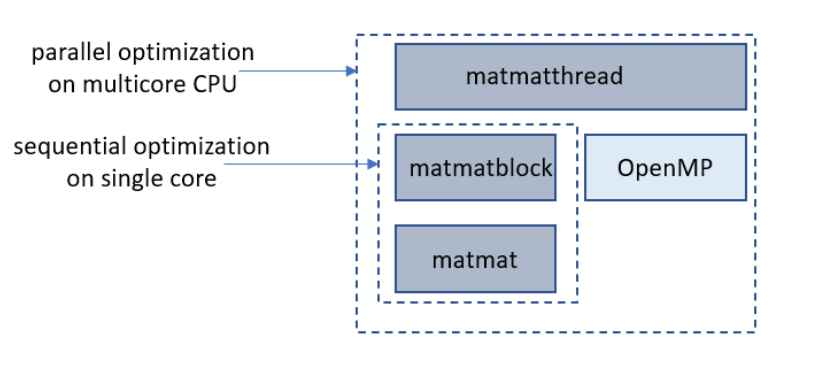
Important (Call Hierarchy)
The function matmatthread MUST call the function matmatblock.
matmatthread: Parallel optimization on multicore CPU (via OpenMP).matmatblock: Sequential optimization on single core.matmat: Basic matrix multiplication.
Exercise
- Compare:
matmatblockandmatmatthread(Gflops, SpeedUp, Efficiency). - Matrix size:
. - Block size:
. - Thread configuration:
SpeedUp and Efficiency
Speed-up Results:
: 1 : 1.98 ( ), 1.99 ( ) : 3.92 ( ), 3.97 ( ) : 7.62 ( ), 7.73 ( )
Efficiency Results:
: 1 : 0.99 : 0.98 ( ), 0.99 ( ) : 0.95 ( ), 0.97 ( )
Deadline
- Date: Tuesday 05/05.
- Deliverable: Single file
matmatthread.ccontaining:- 6 versions of
matmat matmatblockmatmatthread
- 6 versions of
- Test with: square matrices
, block size=2, .