Tool for System Thinking
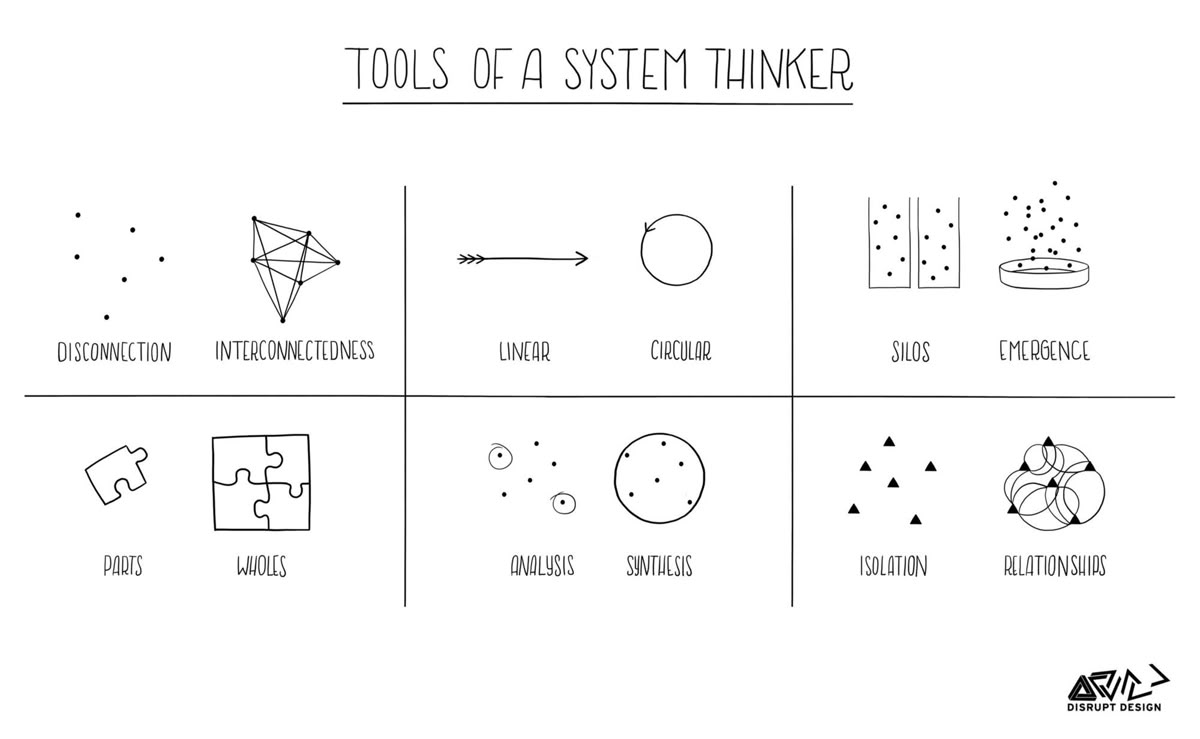
Source: Leyla Acaroglu founder of Disrupt Design
What it means to be a system thinker: being a systems thinker means moving away from a “mechanical” worldview (viewing the world as a machine with replaceable parts) toward a “biological” or “ecological” worldview.
It is the ability to see the world as a dynamic, interconnected, and constantly changing set of relationships rather than a collection of isolated objects. Instead of just reacting to individual events (like “firefighting” a problem), a systems thinker looks for the underlying patterns and structures that cause those events to happen in the first place.
The 6 Key concepts of Systems Thinking
| Concept | The Shift in Thinking |
|---|---|
| Interconnectedness | Moving from seeing things as disconnected dots to understanding that everything relies on something else for survival (biological and social). |
| Synthesis | Moving from linear paths to circular flows. While analysis breaks things down into parts, synthesis combines them to understand the whole and the relationships between them. |
| Emergence | Moving from silos to emergence. This describes how larger entities or patterns arise through the interactions of smaller parts (e.g., a pile of cells ""emerges"" as a living organism). |
| Feedback Loops | Moving from seeing parts to seeing wholes. It involves recognizing that every action has a reaction that ""feeds back"" into the system, either reinforcing a trend or balancing it out. |
| Causality | Moving from analysis (dissection) to synthesis (integration). It’s about understanding the ""why"" and ""how"" things influence each other over time, rather than just seeing a single cause-and-effect arrow. |
| Systems Mapping | Moving from isolation to relationships. This is the practice of visually plotting out the complexity of a system to identify where you can intervene most effectively to create change. |