Structure of an Abstract
Source: write-an-abstract-for-a-research-paper
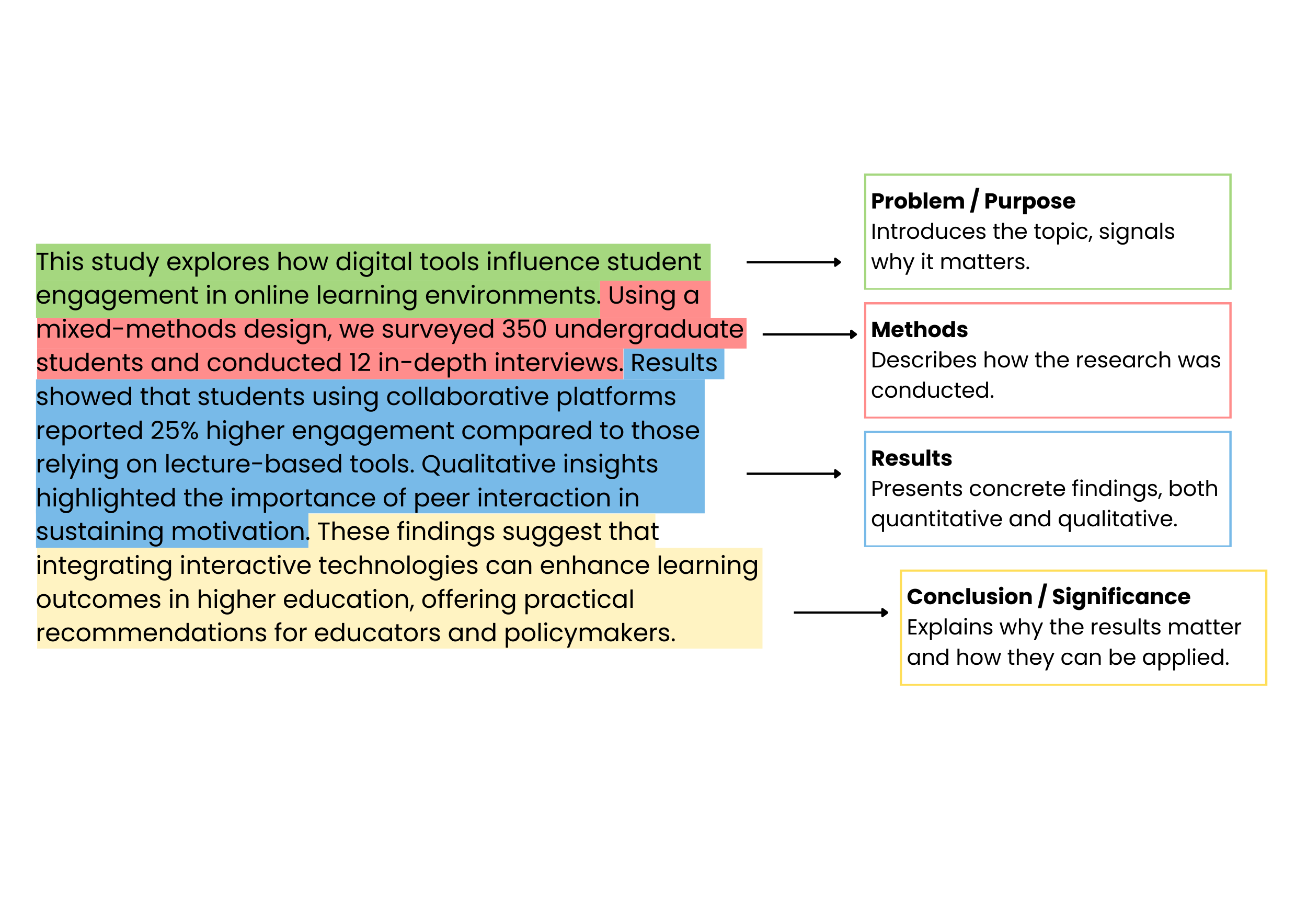
Most journals and conferences expect an abstract to cover four key components:
Problem / Purpose
- Clearly state what your research is about and why it matters.
- Answer: What gap in knowledge are you addressing? What question are you trying to solve?
- Example: “Despite the rapid growth of online education, little is known about how digital tools affect student engagement.”
Methods
- Briefly describe how you conducted the study: your approach, participants, data collection, or analysis techniques.
- Keep it concise—just enough for readers to understand the design.
- Example: “We surveyed 350 undergraduate students and conducted 12 interviews to explore engagement factors.”
Results
- Summarise the key findings of your research. This is often the part readers look for first.
- Be specific: use numbers or clear outcomes instead of vague phrases like “important results.”
- Example: “Students using collaborative tools reported 25% higher engagement compared to lecture-based platforms.”
Conclusions / Implications
- Highlight the meaning of your results and why they are significant.
- Link back to the bigger picture: how do your findings contribute to the field or solve the problem?
- Example: “These findings suggest that integrating interactive tools can improve learning outcomes in higher education.”
Types of Abstract
Not all abstracts are created equal. The style you use depends on your purpose, audience, and requirements. Here are the four main types you’re likely to encounter:
Critical Abstract Don’t just describe, evaluate. A critical abstract goes beyond summary and comments on the strengths, weaknesses, or significance of the study. You might mention the validity of the findings, the reliability of the methods, or the contribution’s importance. These are rare in research articles but appear in reviews or annotated bibliographies. Descriptive Abstract Keep it brief and factual. A descriptive abstract outlines your purpose, scope, and methods but skips results and conclusions. Think of it as a “table of contents in paragraph form.” You’ll often use this style in humanities or theoretical papers. Informative Abstract This is the one you’ll use most. An informative abstract gives the complete picture: background, research question, methods, results, and conclusions. It gives readers enough detail to decide if your paper is relevant without reading the whole thing. Highlight Abstract Here, your goal is to grab attention. You emphasise novelty, importance, or surprising insights. Highlight abstracts are common in conferences, posters, or promotional materials. Use them to spark curiosity, not to explain every detail.