SC - Lezione 20
Checklist
Domande, Keyword e Vocabulary
- Computing Derivatives
- Finite Differences
- Taylor Series
- Forward Difference Formula
- Backward Difference Formula
- Central Difference Formula -
- Algorithmic derivation of general FD formulas
- Effect of the stepsize on FD
- Epsilon Machina
- Differentiation Matrix
- Toeplitz Matrices
- Diff. operator
- FD and polynomial interpretation
- FD for partial derivatives
- FD for the gradient
- FD for the Laplacian
Appunti SC - Lezione 20
Finite Difference formula
A Finite Difference (FD) formula is an algebraic formula that approximates the value of the derivative (of a certain order) of a given function at a point. We can use either Taylor series or algebraic polynomial interpolation.
Taylor Series
Infinite sums of derivatives at
Forward difference formula
It’s used for computing the first derivative. We simply stop at the first order of the Taylor Series.
From which we obtain the formula:
With an error of
Backward difference formula
We simply start from the Taylor series expansion at
With an error of
Central difference formula
We combine the two previous difference formula to get a smaller error.
More formaly we consider the Taylor series expansion of
Then we do the following subtraction:
It’s more accurate than the backward/forward difference formula:
With an error of
Higher-Order Derivatives
For example the second derivatives approximation by considering
By truncating the Taylor series to a desired level of accuracy and rearranging the terms, various FD formulas for first and higher-order derivatives are obtained.
Derivative of a function on a grid
In most applications we want to compute approximations of a derivative of a function on a grid.
A grid is a discrete set of points of
If i have a function of
To approximate derivatives at these grid points, use Finite Difference formulas to compute:
We want to approximate the derivatives of
in other words:
To approximate derivatives at these grid points, use Finite Difference formulas to compute:
Algorithmic derivation of general FD formulas
I have a system of 5 equations in 5 unknowns. Where the unknonws are the derivatives:
Then i write this system in matrix form as:
the solution of the linear system is
With this approach i can derive any formula of the derivative of any grade.
Effect of the stepsize on FD
If i take the smallest
If i take the smallest
where
We consider the minimum of the function
The optimal value is
Note: Consider the function E:
- if
is large, it is convenient to decrease it, since the term dominates. - But, if
is small, the term dominates and the approximate will worsten if you decrease
Differentiation Matrix
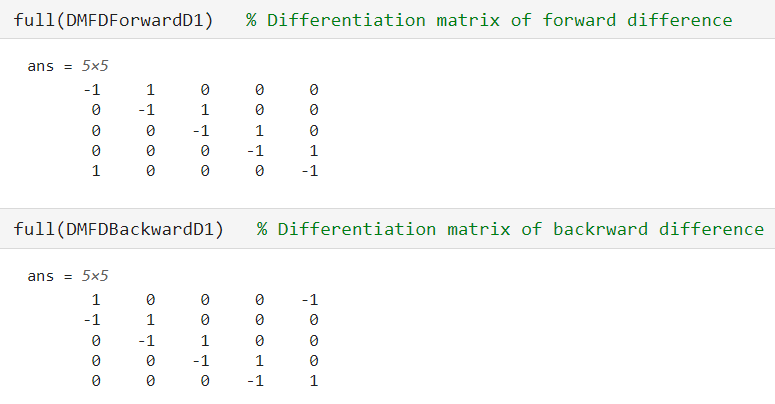
FD formulas on a grid can be implemented as matrix-vector multiplication.
Since the differentiation is a continuos linear operator i.e
and the linearity property is retained by its discrete counterpart.
Each FD formula has an associated Differentiation matrix.
Toeplitz matrices
All differentation matrices are toeplitz matrices that have the equal values on the diagonal
Differentation operator
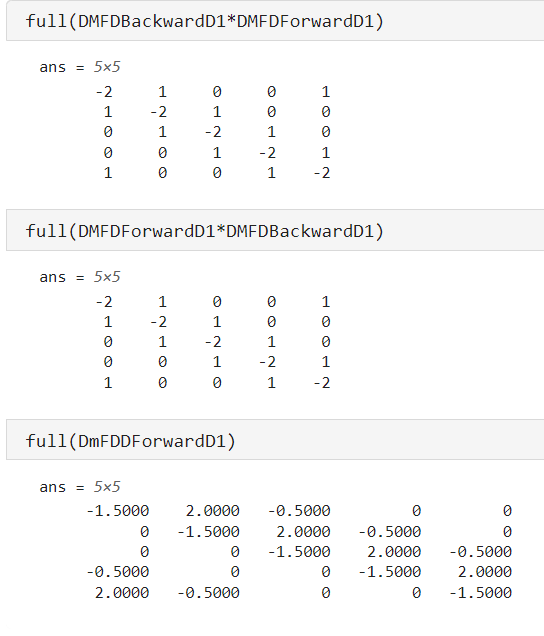
The Differentiation matrix for the central difference formula for the second derivative can be obtained as the product of two Differentiation matrices for first derivative, namely the differentiation matrix for forward difference times the differentiation matrix for backward difference.
In fact in calculus we define the second derivative as the first derivative of first derivative.
FD for partial derivatives
FD can be extendend to functions of several variables and partial derivatives.
Let us consider a function
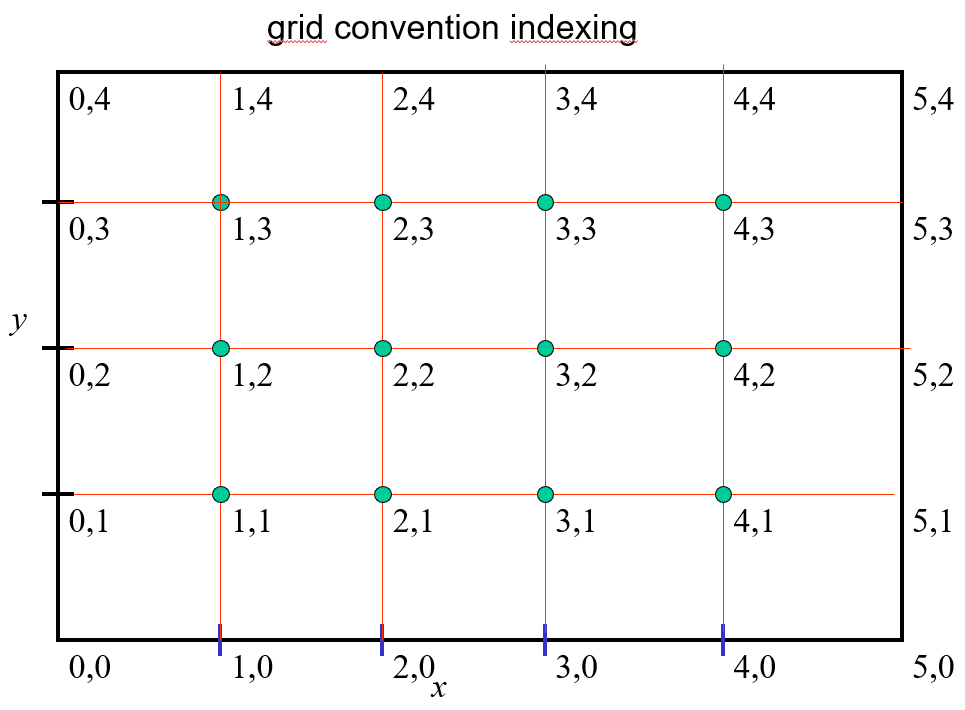 and denote as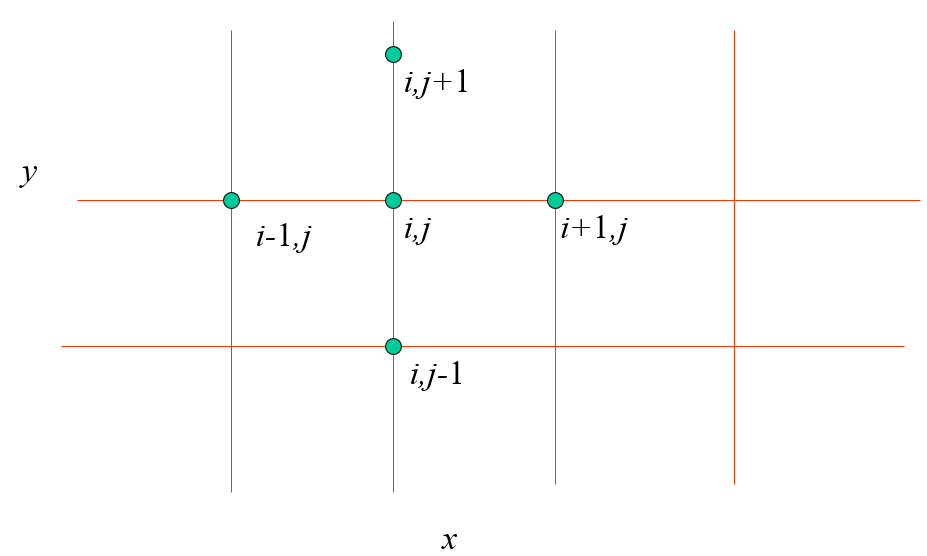
The forward difference formula, for the partial derivative rispect to x:
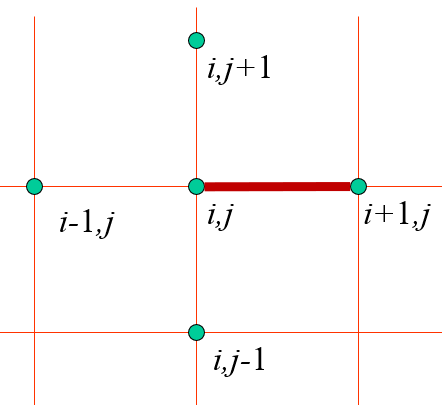
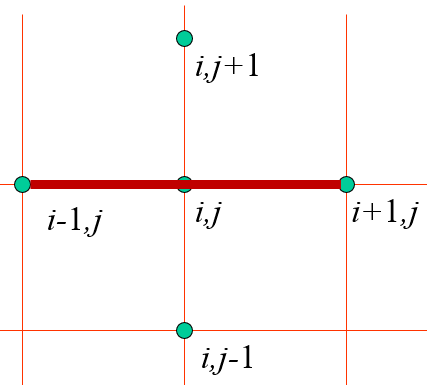
Another example, the central difference of the first derivative, partial derivative w.r.t
FD for the gradient
In Matlab you can use the ”gradient” function to compute the approximated value of
Image example
We consider an image and compute the gradient and we get two image one represent the partial derivative respect to x and the other respect to y
In the example we show that using the gradient Matlab function is more accurate rather than using the backward difference method that provides only a first-order accuracy.
FD for the Laplacian
Recall that the laplacian is the “trace” of the hessian matrix (the matrix of 2nd derivatives in multivariate functions. Trace means it’s the sum of all the derivatives in the hessian matrix. I.e we consider this laplacian:
We apply the central difference formula and get:
that gives this five-points stencil approximation of the Laplacian
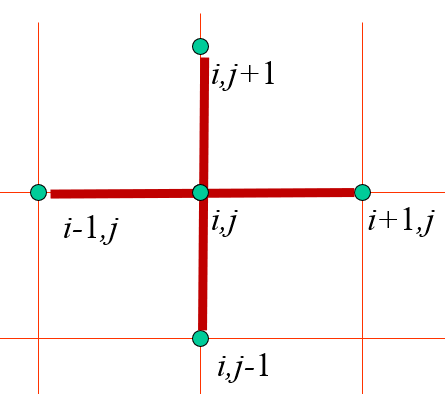
Since the derivative is a linear operator, notice that it’s exactly like doing first the derivative respect to
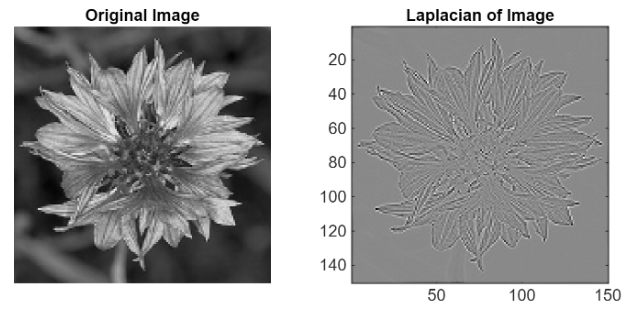
We see in an example that the laplacian can be used on image too, uses more informations (2 derivative of the function), so the edges are quite good represented, better than using the gradient.
Sommario
Nota: In pratica ti devi ricordare le 3 difference formula, le immagini della griglia e delle linee rosse. E ricordare il fatto che la differenziazione su una griglia è un prodotto matrice vettore Basta sapere che esiste l’algoritmo per derivare le formule non c’è bisogno che lo impari a memoria.