SC - Lezione 31
Checklist
Domande, Keyword e Vocabulary
- DWT Application: denoising a signal
- Median Absolute Deviation
- Universal Threshold
- 2D-DWT and its inverse
- Matrix G
rows and columns - Single Level 2D-DWT steps
- LL, HL, LH, HH matrices
- approximation, horizontal, vertical, diagonal details
- Time Complexity of the 2D DWT
- Inverse 2D-DWT
- JPEG2000 Image Compression Algorithm
- CWT vs DWT time complexity
- CWT and DWT in Functional Analysis
- Orthogonal basis vs Overcomplete dictionary
- CWT as series of inner product in functional analysis
- DWT/FWT as linear operator
- Heisenberg Uncertainity
- Real-world examples of signal processing
- High-pass and low-pass filters in time domain
- Impulse response
- Ideal low/High pass filter
- Finite Impulse Response Filter
- Hamming window
- Band-pass filter
Appunti SC - Lezione 31
DWT Application: denoising a signal
We consider a signal and we apply some noise to it
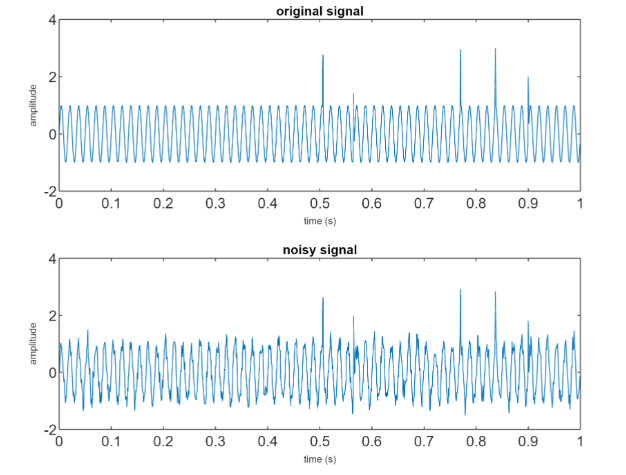
We use “transient spikes” since it’s a non-stationary noise. We apply the CWT up to the 4 decomposition level.
Then we need to estimate the noise level, that is the standard deviation
A reliable estimate of the standard devitation is based on the Median Absolute Deviation (MAD) that is: MAD(
The threshold is commonly chosen as the so-called universal threshold given by:
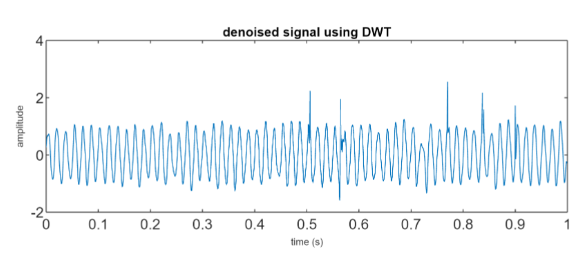
Then, to apply the denoise we set any entry below that threshold, in the detail vectors, to 0 :

2D-DWT and its inverse
The 2D-DWT involves the multiple use of the DWT in two directions.
The matrix G that represent our signal is decomposed into multiple levels of detail and approximation.
If the
Single level 2D-DWT
The steps are the following: first an horizontal transformation is applied and
The matrices after the horizontal transformation:
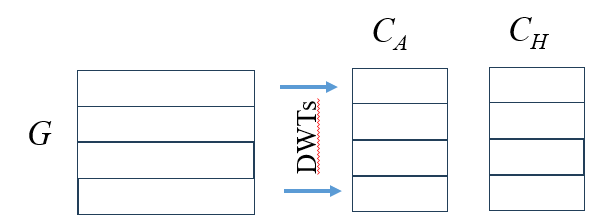 They are vectors of coefficients for each row, that are just stored as a horizontal approximation coefficients that we call
Then, in the vertical transformation:
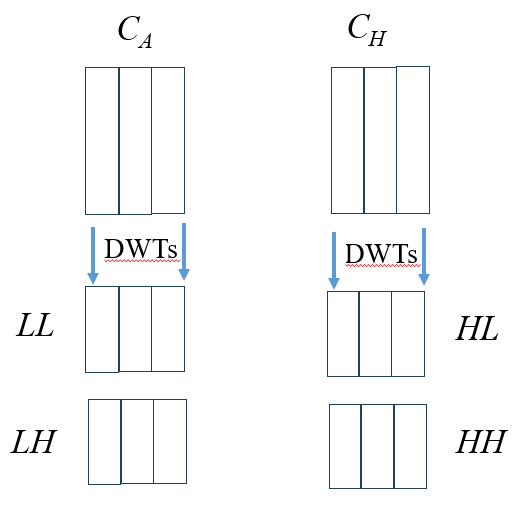 We apply the DWT again to each vector, obtaining
This process and be mathematicall represented as follows for a single level decomposition:
- approximation (Low-Low, ): result from applying low-pass filters in both horizontal and vertical directions. They capture the smooth parts of the image without rapid intensity changes
- horizontal detail (High-Low, ): result from applying a high-pass filter horizontally and a low-pass filter vertically. They capture horizontal details or edges
- vertical detail (Low-High, LH): result from applying a low-pass filter horizontally and a high-pass filter vertically. They capture vertical details or edges
- diagonal detail (High-High, HH): result from applying high-pass filters in both directions. They capture the high-frequency content that often corresponds to changes or features oriented diagonally, i.e. both horizontally and vertically.
Time Complexity
Inverse 2D-DWT
Reconstruct the original image
The algorithm can be summarized in:
- upsampling the four matrices
- Convolution along the rows of
and with a low-pass reconstruction filter - Convolution along the rows of
and with a high-pass reconstruction filter - Sum the filtered outputs from
and to form an intermediate horizontal approximation - Do the same with
and for an intermediate horizontal detail - Upsample again the columns of the two intermediate matrices
- Convolve the columns of the intermediate approximation matrix with the low-pass reconstruction filter
- Convolve the columns of the intermediate detail matrix with the high-pass filter
- Add the filtered outputs from both convolutions to reconstruct the original signal
Time Complexity is the same.
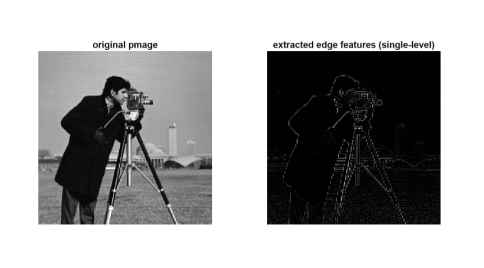
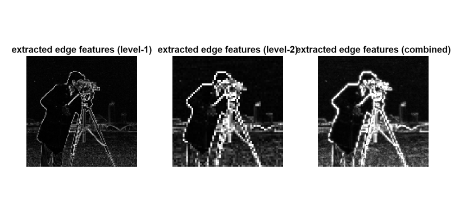
JPEG2000 - Image compression algorithm
JPEG2000 is a standard for image compression that significantly improves over its predecessor JPEG, it uses the FWT. It can apply both lossless and lossy compression.
How the algorithm works
- Preprocessing: the image is preprocessed, for instance the image could be divided into smaller blocks and a color space transformation could be applied
- 2D-DWT: apply the transformation as we saw in this lesson, we obtain 4 subbands matrices
- Subsequent Decomposition: the matrix
(that represents the coarse approximation of the image) is further decomposed into subsequent levels, progressively extracting finer details - Quantization: the wavelet coefficients are then quantized. In lossy compression, this step significantly reduces the amount of data by approximating the coefficients to a lower precision;
- Entropy coding: the quantized coefficients are then encoded using entropy coding techniques which further compresses the data by exploiting the statistical properties of the coefficients; (We dont’ go in deep with this)
- Post-processing: the encoded data are organized into a codestream ready to be stored or transmitted
Matlab simplified code example
We discuss a simple educational Matlab code that demonstrate a basic implementaton of JPEG2000-like compression using 2D-DWT
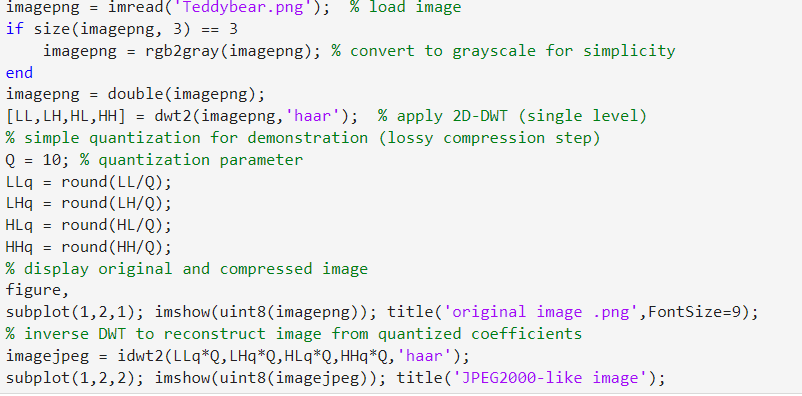
The core step is quantization. By dividing the wavelet coefficients by a quantization parameter
CWT vs DWT - Time complexity
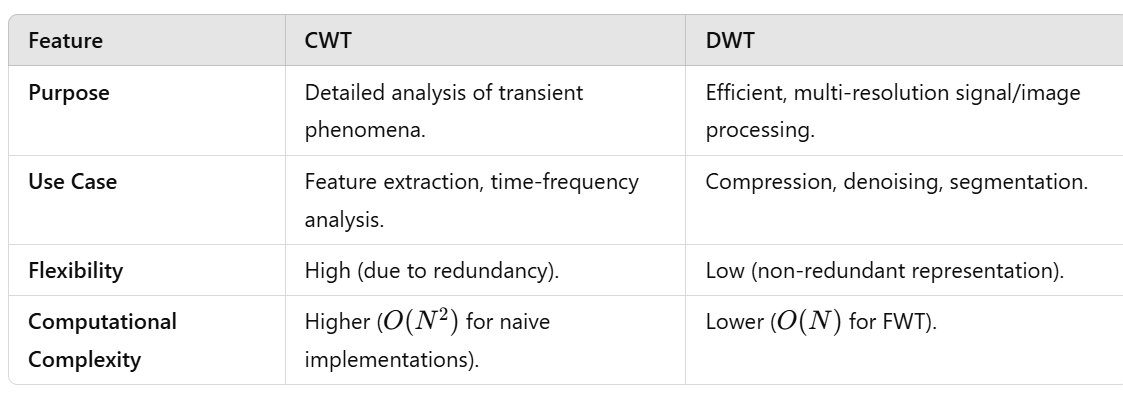 The choice between DWT and CWT depends on the application requirements.
If one needs a highly detailed analysis where the exact scale and position of signal features are crucial, CWT might be the better choice despite its higher computational cost.
On the other hand, if one requires efficient computation and storage, especially for tasks like image compression, denoising, or when working with large datasets, DWT’s discrete and compact representation offers significant advantages.
A glimpse to CWT and DWT in Functional Analysis
See also: A glimpse to Fourier series and Transform in Functional Analysis
Unlike the FT, where sines and cosines form an orthogonal basis in
There are notable exceptions, such as the Haar wavelet and certain Daubechies wavelets, which are designed to form orthogonal bases.
A wavelet family
Orthogonal basis vs Overcomplete dictionary
An orthogonal basis is a set of vector, orthogonal to each other, that allow the unique, efficient, and non-redundant representation of every element in a vector space.
An overcomplete dictionary is a set of vector (or functions) that is used to represent elements in a vector space, but it contains more vector than necessary to span the space (that’s why we say it’s redundant). This imply that the same vector can be represented in multiple (in fact infinite) ways.
CWT vs DWT and orthogonal wavelets
- CWT prefers non-orthogonal wavelets for flexibility and redundancy
- DWT uses orthogonal and compactly supported wavelets.
CWT as series of inner product
CWT is a linear operator from
Consider the CWT:
In
Parseval-like theorem for CWT
We can use the previous formula to express a Parseval-like theorem for CWT as:
is a proprtional factor that depends from the chosen wavelet
DWT/FWT as linear operator
It can be shown that the DWT/FWT is a linear operator from
where
As we said, some wavelets are orthogonal, therefore
It can be shown that the overall multi-level DWT (multiresolution) can be tought of as applying a sequence of orthogonal transformations to the input vector, and the entire process can still be represented by an orthogonal matrix.
Heisenberg Uncertainity Principle
This principle imposes a theoretical limit on how precisely we can localize a signal simultaneously in both the time and frequency domain. This limit applies to all time-frequency analysis methods that we saw (FT included).
More formally:
is the uncertainity in time is the uncertainity in frequency
It’s impossible to arbitrarily reduce uncertainty in both the time and frequency domains simulanteously.
From real-time analysis to intelligent insights: integrating signal processing and AI
As real-world examples, we can consider Biomedical signal processing and Vibration analysis in industry.
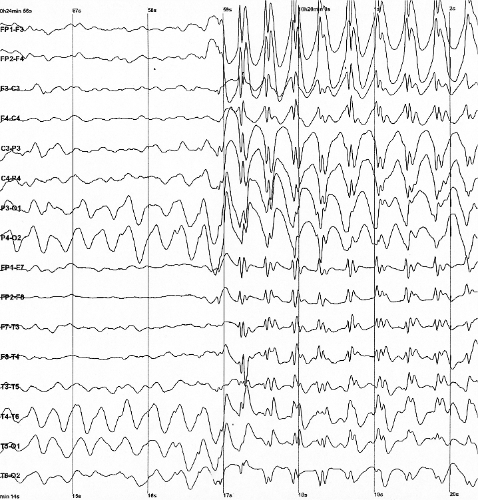
Electroencephalogram (EEG) devices or Electrocardiogram (ECG) monitors often include embedded FFT analysis to provide real-time frequency information about brainwaves or heart rhythms. As second step, techniques like STFT or wavelet transforms are used to analyze non-stationary components, such as detecting epileptic seizures or arrhythmias. As a further step, Machine learning/AI algorithms are applied to classify different signal patterns (e.g., identifying neurological disorders or predicting cardiac events).
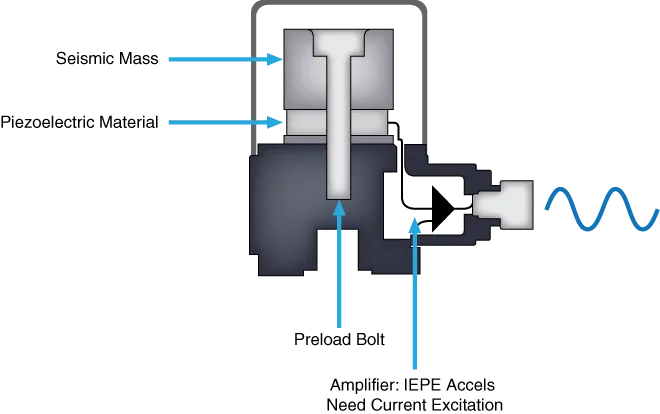
Vibration sensors or accelerometers in machinery (e.g., for predictive maintenance) embed FFT analysis to monitor frequency components of vibrations. Advanced analysis using CWT or DWT helps identify transient phenomena, like the early onset of bearing failures or gear faults. As last step, AI-based predictive models analyze patterns over time to forecast equipment failure and optimize maintenance schedules. accelerometer_cross_section.webp
High-pass and Low-pass filters in the time-domain
We have discussed DFT,FT,CWT and DWT to filter out specific frequencies from a signal.
However, designing and applying filters, such as low-pass or high-pass filters, does not inherently require any of the previous technique.
Filters can be designed and implemented directly in the time domain using their “impulse response”. Then the effect of the filter is realized through convolution of the signal with the impulse response.
Recall that the impulse response
low-pass and high-pass filters are used for example for the efficient implementation of the DWT.
If
by the superposition property, the system response to
Low pass filter
Ideal low pass filter: passes all frequencies below a cutoff frequency
In the time domain, the impulse response
The ideal low pass filter is a rectangular function. Its inverse is a sinc function:
A low pass filter designted with a cutoff frequency of
Constructing an ideal, infinite, low pass filter is impractical
Finite Impulse Response Filter (Low-Pass)
A window function is used to truncate the sinc function and gradually reduce its amplitude towards the edge.
For example let’s see the Hamming window:
is the total width of the window in time. By sampling this continuos function at specific time intervals, we obtain the discrete version. 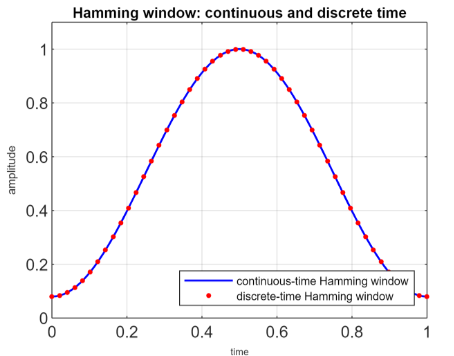
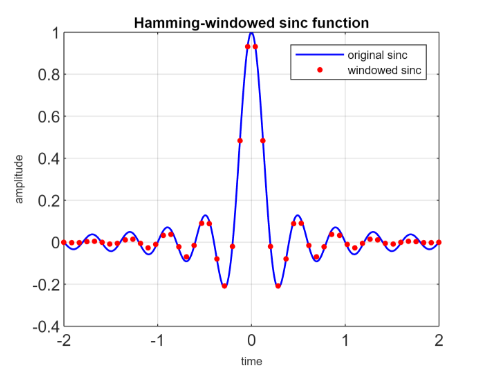
The impulse response of the FIR low-pass filter is:
High pass filter
Ideal High-pass filter
This ideal filter passess all frequencies above a cutoff frequency
The filter could also be expressed as
The time-domain impulse response
This technique of expressing an high-pass filter as inverted low-pass filter is called spectral inversion.
The impulse response of the FIR high-pass filter is:
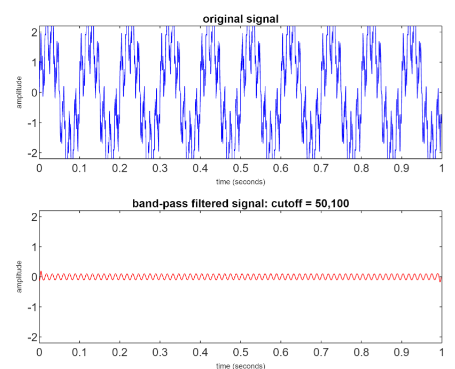
Band-pass filter
A band-pass filter is a filter that allows signals within a specific range of frequencies (the “band”) to pass through while attenuating frequencies outside this range. It combines the effects of both a high-pass filter (removing frequencies below a lower cutoff) and a low-pass filter (removing frequencies above an upper cutoff).
We may construct this filter using an approach known as filter cascading or filter stacking. In essence, the high-pass filter is sequentially applied to the input signal to remove low-frequency component. Then we do the same thing with the low-pass filter to remove high frequency components.