Domande, Keyword e Vocabulary
- Aliasing
- temporal aliasing and spatial aliasing
- Nyquist-Shannon sampling theorem
- What is a bandlimited function?
- Nyquist rate
- Formula for reconstructing f(t)
- sinc function
- Infinite Number of samples
- Demonstration of the Aliasing phenomenon
- Example: minimum number of samples for sampling correctly a signal
- Computing Nyquist rate, Sampling period, and Minimum Number of samples
Appunti SC - Lezione 28-29
Aliasing
In the previous lesson we saw the Gibbs Phenomenon and how it depends from the FT.
Aliasing is a different problem that depends on the sampling.
Formally, two different continuos functions becomes indistinguishable after sampling. This leads to distortion during the reconstruction process, causing the reconstructed function to differ from the original. Aliasing can occur in both the time domain (temporal aliasing) and the spatial domain (spatial aliasing).
Nyquist-Shannon sampling theorem
Let
What is a bandlimited function?
A function that contains only a finite range of frequencies
Nyquist rate
When
Formula for reconstructing f(t)
The following formula is used:
Where
Is the normalized sinc function:
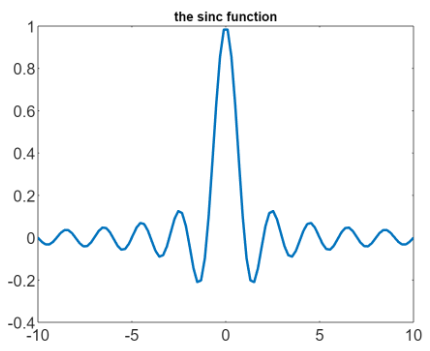
The Nyquist-Shannon theorem does NOT requires an infinite number of samples!
Demonstration of the phenomenon
Consider a period of
defined on the interval
Discretization: (Sampling) Consider a grid of equispaced
where
Then assume that
Then by doing algebraic manipulation we get:
For the reason why
The conseguence of the above formula is that, on the choosen grid of
Note that we get the same result if
Simple example computing the minimum number of samples required for sampling correctly a signal
Consider this function:
The corresponding sampling period,
How to compute the Nyquist rate
Consider
The fundamental frequency
for
cycles per unit time. The Nyquist rate is obtainted as twice the maximum frequency present in the signal, so:
How to compute the minimum number of samples
- the interval length is
;
Conseguences of choosing an insufficient number of samplings
If we choose
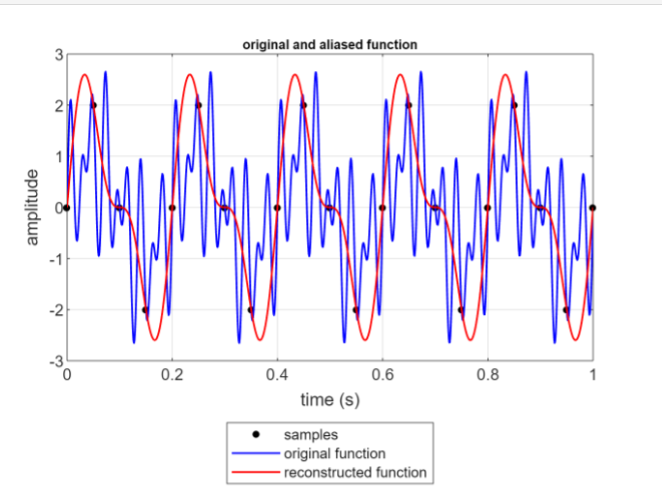
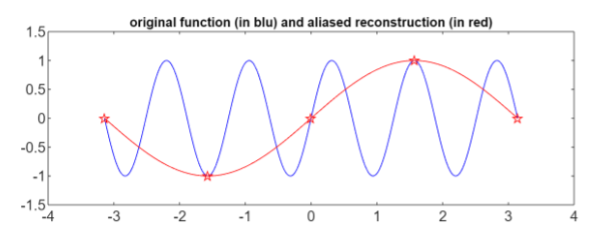 We observe that the aliased reconstruction in red is
The reconstruction gives a function of frequency:
- in the example N=4
Ofcourse, this doesn’t happens when 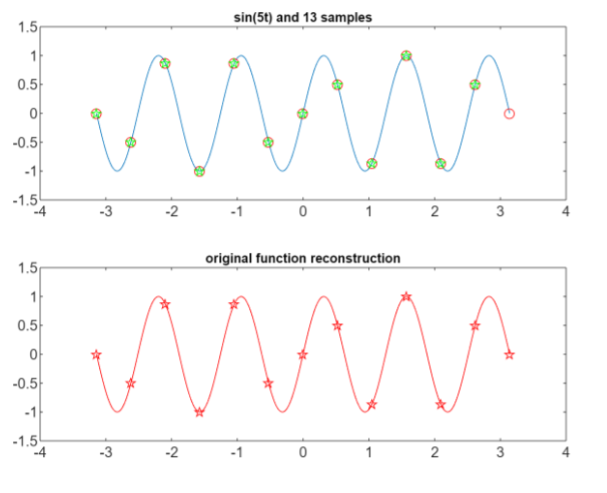
More complex example of what happens when a function is sampled below the Nyquist rate
Consider the function:
This function combines multiple sine waves of different frequencies:
and the Nyquist rate is:
For convenience, since for example a component of the signal
then we have that
Suppose that the sampling rate is set to
We need to compute
Since
Nyquist frequency
the frequency
is called the Nyquist Frequency (not to be confused with
The relationship between aliasing and the Nyquist frequency is the following:
If
Back to our example: only
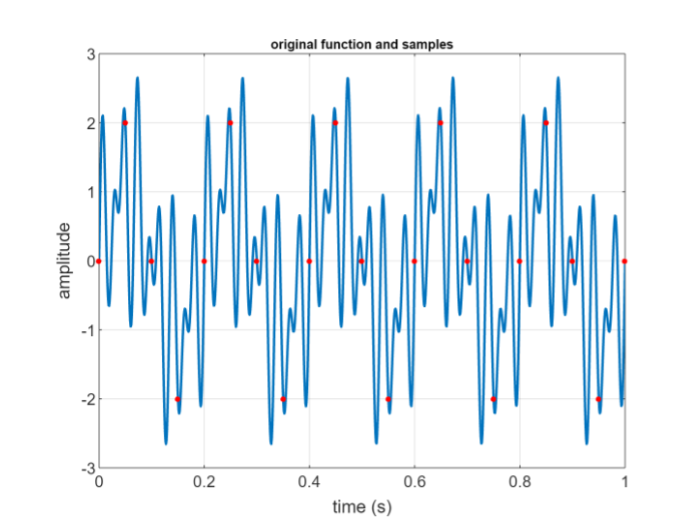
Relationship between Nyquist frequency and Nyquist Rate
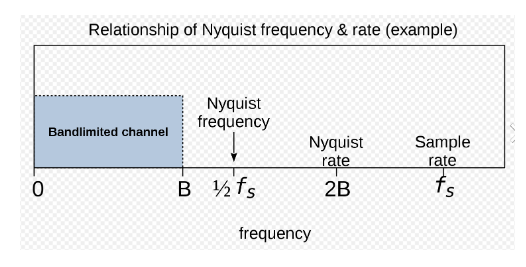
- Nyquist rate
: 2 times the highest frequency (bandwidth); it’s a property of the function (a continuos-time signal) - Nyquist frequency
: half the sampling rate; it’s a property of the sampled function (a discrete-time digitized sound)
The Sinc Function
Property of the Sinc Function
It can be used for reconstruct any bandilimite function through Lagrange interpolation of a set of sampled values
is a stepsize on the grid
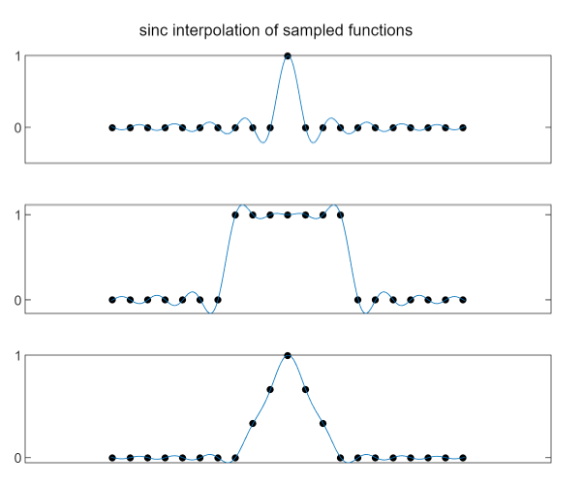
The sinc interpolation of a function
Convolution: the above formula can be seen as the convolution of the sampled function
Choosing
Fourier Transform
The inverse is:
We used the circular frequency
Dirac Delta
It’s not a function in the traditional sense but a generalized function. It has the following key properties:
- unit area: the integral is 1:
despite his infinite height - sifting property:
it can sift out the value of a function at a specific point
The FT of
Properties of the Fourier Transform
is a linear operator: is - The FT of
is
Convolution
The FT of a continuos convolution of two functions:
For continuos functions, the convolution is defined as:
While, when we saw the discrete convolution, we saw it used the summation
Another related property of the FT is that:
Derivative
The FT of
Duality
if the FT of
Bandlimited function
If the FT of
Parseval theorem
Recall that this also holds in the discrete case.
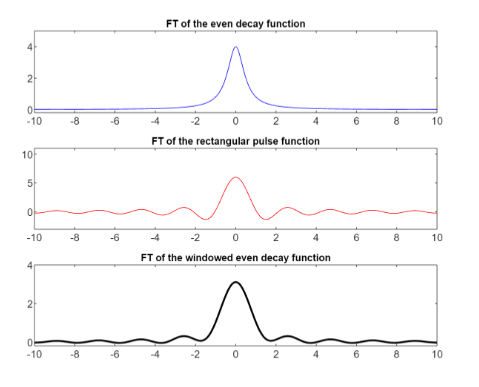
Example
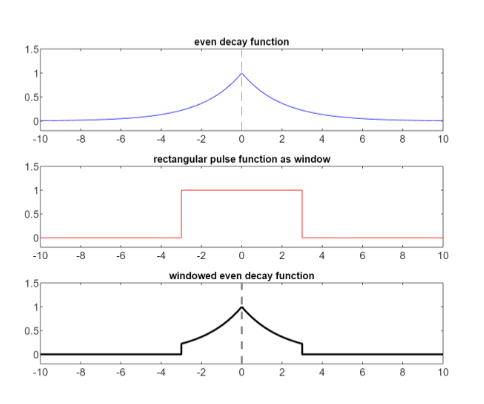
- The even decay function defined as:
restricted in the finite interval - The even rectangular function we call
, of half-length - The “windowed even decay function” is obtainted by convoluting the two functions in the frequency domain:
is equivalent to
In the frequency domain:
How to compute the Fourier Transform
The algorithm is similar to the one designed for approximating Fourier Coefficients and partial sums of a Fourier Series.
This algorithm only approximate the value of the FT of a function, since it would be impossible or too costly to compute the entire function.
Given
The main steps of the algorithm for the FT are:
- define the vector of samples
such that , - Compute the DFT
of - Reorder the vector
- Append a copy of the first component
a the end and multiply all entries by the scaling factors: , for - Compute the frequency
,
What's the difference with the algorithm for computing the FS?
With respect to the fourier series algorithm, here we have an extra step at the end: compute the frequency
,
A glimpse to Fourier series and Transform in Functional Analysis
Hilbert Space in
Consider a space of functions
The previous identity define the
The inner scalar product between two function is defined as:
Now consider the functions:
for
Now consider the Fourier coefficients
following this point of view, the Fourier Series of
Hilbert Space in
Now consider the space of functions
This identity define the
Consider the functions
They form an orthogonal basis, since it can be shown that:
The FT of a function