SC - Lezione 25
Checklist
Domande, Keyword e Vocabulary
- Discrete convolution of two signals
- Parseval Theorem (2-norm)
- Length of the output signal
- Linear Discrete Convolution and Circular Discrete Convolution
- How to avoid the zero padding
- Basic facts about convolution
- Discrete Short-Time Fourier Transform
- Support of a function (and why we recall it)
- bins
- Spectogram
Appunti SC - Lezione 25
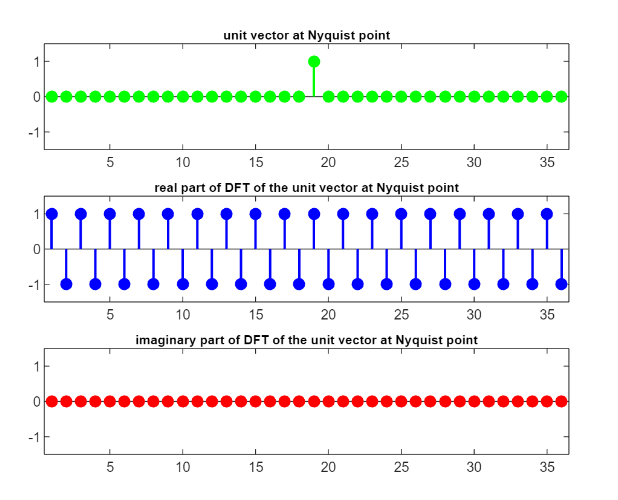
Nyquist Point
Consider a vector
The DFT of the unit vector at Nyquist point
Parseval Theorem - 2-norm of input and output vector of the DFT
the 2-norm of the input signal to the DFT:
Convolution of two signals
We have two signals (vectors),
Suppose
The discrete convoluton,
How can we set the length of
- Linear Discrete Convolution: The resulting vector
has a length of , a zero padding is applied to the values of outside the range. - Circular Discrete Convolution: In this case,
is treated as periodic. Any shifts that move elements beyond the last position wrap around to the beginning, creating a circular or periodic structure. Formally the component is intented as: and the resulting vector is of length
When formally defined on infinite sequences rather than finite vectors, the discrete convolution becomes:
To avoid the zero padding: we reverse the vector
Basic facts about convolution
Consider these two signals
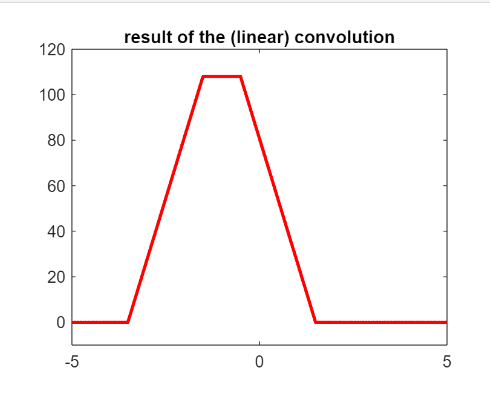
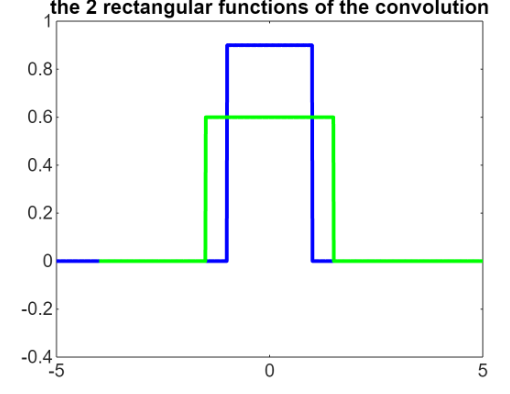 what is the output shape? It’s a trapezoid.
Discrete Short-Time Fourier Transform
Recall the example from the previous lesson where we used the DFT to recover the 11 digits of a phone number. In that example, we attempted to achieve this manually by applying the DFT to a segment of the signal in the time domain.
There is a way to do this “automatically” by using the Discrete Short-Time Fourier Transform (STFT). The STFT divides the frequency range into bins.
Unlike the DFT, the STFT provides the time-varying frequency spectrum of the entire signal. It is defined as:
Where:
is the input discrete signal, is the STFT of at time index and (angular) frequency , is the discrete window function centered around the time . The window function is used to isolate a segment of the input signal .
Support of a Function: A function defined over
We skipped the detailed explanation of how this works.
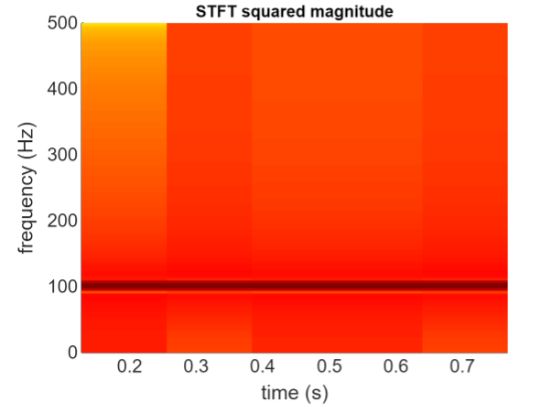
Spectogram
The Matlab function spectrogram computes the STFT of a signal. It returns a complex matrix 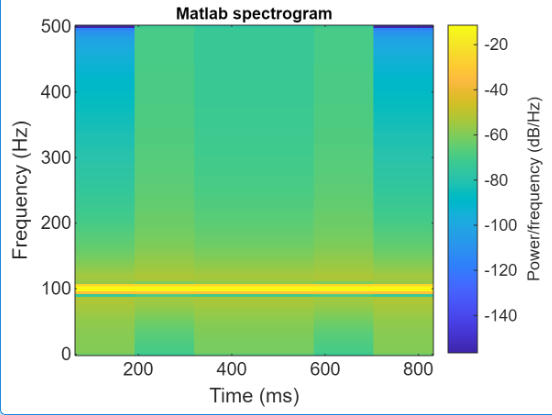
The magnitude squared of