SC - Lezione 23 - Root of Unity, DFT definition, Frequencies, Amplitude Spectrum, DFT as matrix-vector product
Checklist
Keyword
- Root of Unity
- Discrete Fourier Transform
- Magnitude (amplitude) and phase
- DC component
- Fundamental Frequency Component of the signal
- Sampling Rate and Sampling Frequency
- Frequency Resolution
- Sampling Period
- Recap on Frequencies
- Amplitude Spectrum
- Conjugate Symmetry
- Single-sided spectrum
- Quasi-unitary property
- Hermitian matrix
Appunti SC - Lezione 23
Root of unity
It’s a number called
Which means that it has magnitude 1 and angle
which is the 4th quadrant (see recap complex numbers)
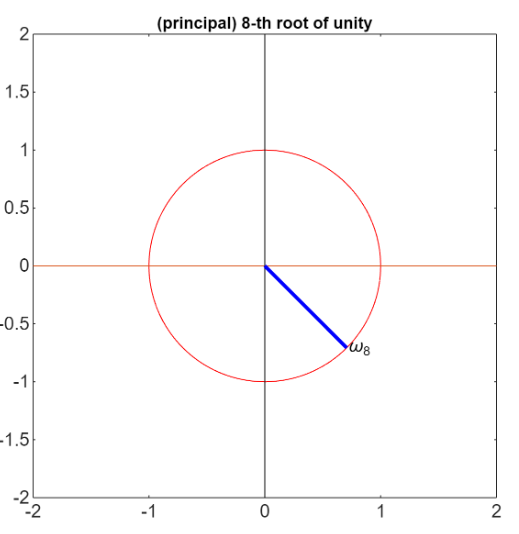
Property of the root of unity: if we raise omega to N we have that:
Omega N is the N-th root of unity. If you raise this number to N you get exactly 1
Alternative Notation
The definition is the same as if you use the minus sign. The minus sign is used in the fourier analysis. Usually another notation is without the minus, that is also good but we prefer the minus definition.
Raising
Consider the previous image:
It’s
There are just
Discrete Fourier Transform
What it is used to: analyize discrete signals Idea: transform samples (such as sound waves) from a time domain to a frequency domain
Definition: The input of the DFT is a finite, discrete signal (a vector) and the output is a finite, discrete signal (a complex vector) in the frequency domain.
The input to the DFT is a vector
the k-th element of
for
Note also that if
Each element
Recap of the elements of a signal
Magnitude: the magnitude of each
Fundamental Frequency Component of the signal:
Note that we defined the frequency of the
The physical frequency depends on the sampling rate
Example
I have the signal represented by the function
is the frequency of the cosine wave; it oscillate cycles per second is the time in which we observe the signal, goes from 0 to 1
if
Sampling Frequency: to digitalize this signal (infinite to finite), we decide the value
For example if
Frequency Resolution:
Amplitude Spectrum
It is defined as
is the vector of moduli of the components of the complex vector (to which we applied the DFT). is the number of samples used for sampling the signal.
It shows how much of each frequency is present in the signal, providing insight into the signal’s frequency content and strength at each frequency component.
We consider in an example this signal:
signal = sin(2*pi*60*t) + 0.9*sin(2*pi*120*t);
which is given by the sum of two sinusoids.
Conjugate Symmetry (or Nyquist Index)
There is a symmetry between negative and positive frequencies, since mathemtically they are one the complex conjugate of the other.
So they carry the same information and it’s redundant to consider both in practical application. We consider only the single-sided spectrum
Example of analysis of audio signals
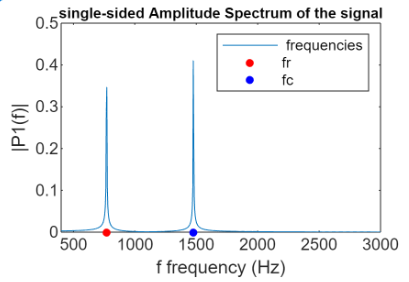
Classical example of the Touch-tone telephone dialing, that uses the dual-tone multi-frequency signaling (DTMF) standard, associated with each row and column is a frequency.
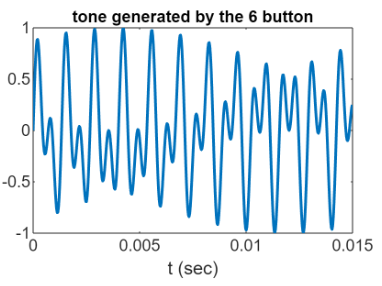
The tone generated by pressing the button in position
- fr is the frequencies of the rows
- fc is the frequencies of the columns
Like before we make the sum of the two frequencies
and .
Example 2
Now instead of just press 1 button i press a sequence of buttons, 11 digits.
The recording is this:
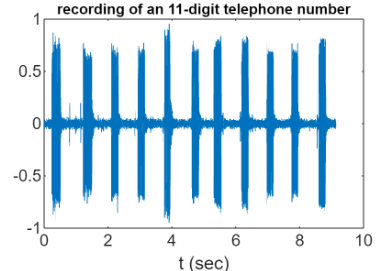
If we compute the DFT we see that:
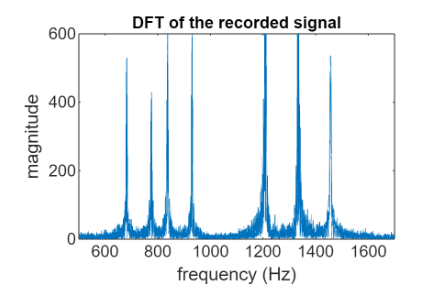 There are 7 peaks, corresponding to the seven basic frequencies but we cannot determne the individual digits.
We don’t know which frequency come first, we don’t know the distribution over time and this is the main problem over DFT.
It make sense, because when you transform a signal from the time domain to the frequency domain, and you analyize this signal, you don’t have the information about time.
There are 7 peaks, corresponding to the seven basic frequencies but we cannot determne the individual digits.
We don’t know which frequency come first, we don’t know the distribution over time and this is the main problem over DFT.
It make sense, because when you transform a signal from the time domain to the frequency domain, and you analyize this signal, you don’t have the information about time.
We have to break this signal into 11 equal segment and anaylize them separately.
DFT as matrix-vector product
The DFT can be interpreted as matrix-vector product.
is the column vector of N components of input - DFT matrix
, square is the output
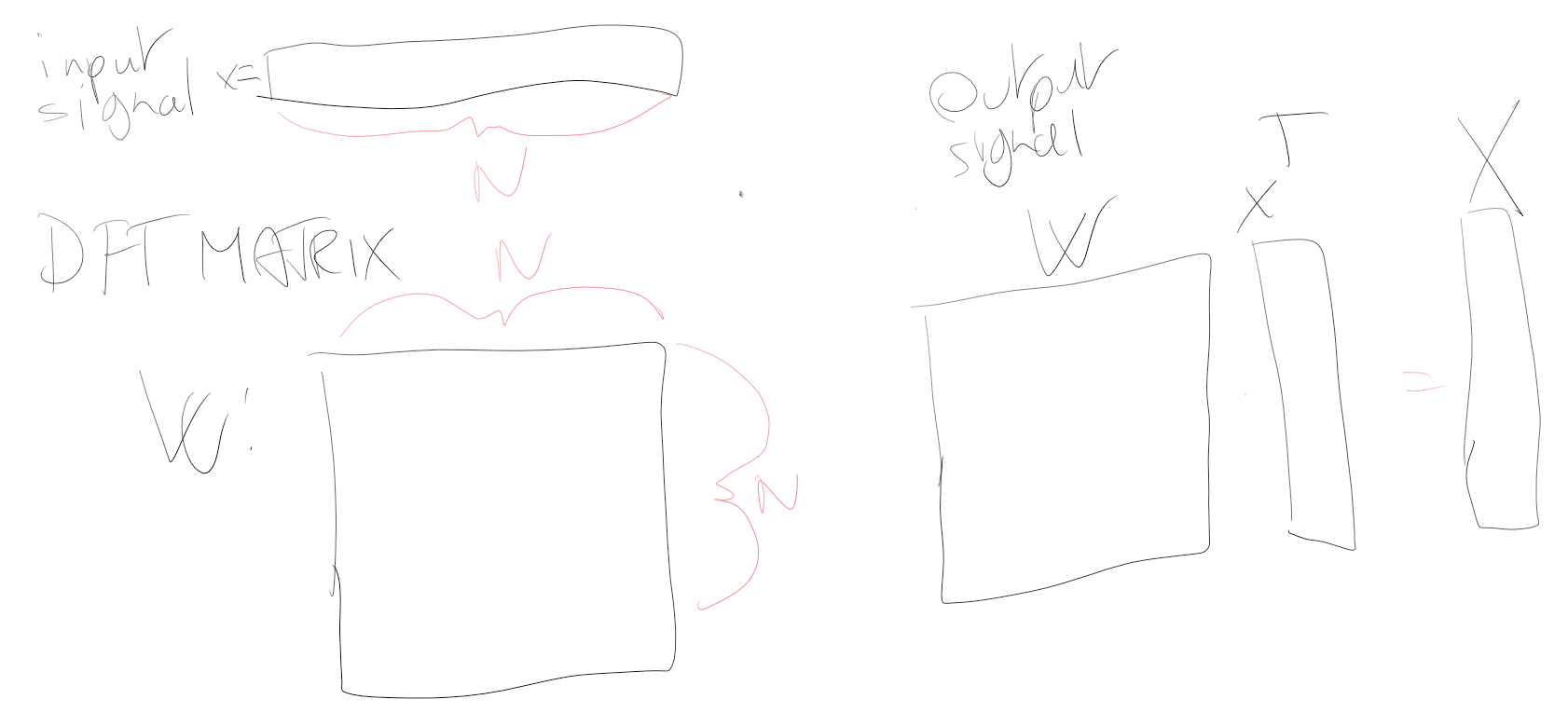
The generic entry of
What we are doing is projecting
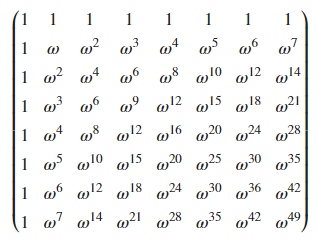
For example in Symbolic Matlab here is the DFT matrix (order 8):
Hermitian Matrix (or conjugate symmetric)
A complex matrix
It’s the complex correspective of the symmetry.
If
DFT Matrix is not Hermitian since
Conjugate Symmetry Property and Quasi-unitary property
Conjugate Symmetry Property:
Such conjugate symmetry of
Quasi-unitary property: The DFT matrix enjoy of the following property: