Recall:
Random Variables, Distribution Functions and Probability Functions
- Source: “All of Statistics - A concise course in statistics”
Random variable is defined as a mapping:
that assigns a real number
Intuition: link sample spaces and events to data
Example:
- Flip a coin 10 times. Let
be the number of heads in the sequence then - More complex: Let
be the unit disk. Consider drawing a point at random from . A typical outcome is of the form . Some examples of random variables are: , and , and
It is possible to define
Then
Distribution functions and probability functions
The cumulative distribution function (or distribution function) or CDF is the function:
Property: the CDR contains all the information about the random variable.
Theorem 1: Let
Theorem 2: A function
is non-decreasing: implies that is normalized i.e and is right-continuos: for all where
Discrete Probability function (or probability mass function)
The probability function is then defined for
Properties: Thus
for all
The CDF of
Probability density function (PDF)
A random variable
and for every
The function
and
Example
Suppose that
Clearly
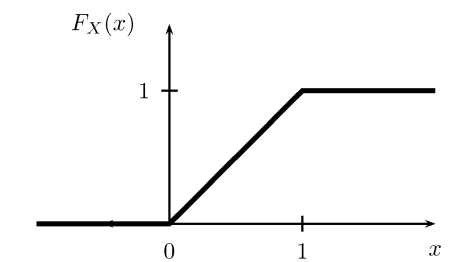
Continuos random variables can lead to confusion
Note that if
is continuos then for every . , this is true only for discrete random variables. For continuos random variables you need to integrate to get a probability. Unlike discrete, a PDF can be bigger than 1 For example: if for and 0 otherwise, then for and so it is a well-defined PDF even though in some places.
Lemma:
- If
is continuos then:
Inverse CDR of quantile function
Let
- for
stand for infimum i.e., the smallest value of that satisfy the condition is the set of all values of where CDF exceeds
If
Intuition: gives the value of
is the first quartile is the median (or second quartile) is the third quartile
Example
Suppose
- CDF:
- To find
: look for the smallest where that is 3 because so the quantile = 3.
Definition: equal in distribution: two random variable
Some Important Discrete Random Variables
Notation
It is traditional to write
to indicate that has distribution
Point Mass Distribution
The Point Mass Distribution (pmf)
- The pmf is
for and otherwise
Discrete Uniform Distribution
Let
We say that
The Bernoulli Distribution
The probability function is defined as:
Intuition: Let
Binomial Distribution
The Binomial distribution describes the probability of getting exactly
→ number of ways to choose successes from trials → probability of success → probability of failure
Intuition: suppose we have a coin which falls heads up with probability
Paremeters
is a parameter i.e a fixed real number. Usually it is unknownw and must be estimated from data; that’s what statistical inference is all about. Statistical inference machine learning
Geometric distribution
Poisson Distribution
Some Important Continuos Random Variables
The Uniform Distribution
where
The distribution function is:
Normal (Gaussian)
The Normal plays an important role in probability and statistics. Many phenomena in nature have approximately Normal distributions.
Central Limit Theorem: the distribution of a sum of random variables can be approximated by a Normal distribution.
Traditionally, the standard Normal random variable is denoted by
Properties:
- If
then - If
, then - If
, are independent, then: - It follows from the first propert that if
then:
Thus we can compute any probabilities we want as long as we can compute the CDF
Gamma Distribution
For
The exponential distribution is just a Gamma(
If
Cauchy Distribution
The
The Cauchy Distribution is a special case of the
The X2 distribution
If
Continuos to this part: Bivariate Distributions, Marginal Distributions, Independent Random Variables, Conditional Distributions, IID Samples