NLP - Lecture - Transformers
In the previous topic, attention in sequence models we introduced attention. Transformers are based on these, but employs self-attention.
First, left-to-right (also called casual or autoregressive) language modeling is introduced through transformers.
Attention can be thought as building contextual representations of a token’s meaning by attending to and integrating information from surrounding tokens.
Recall that in [[NLP - Lecture - Static Word Embeddings|[NLP] Word Embeddings]], we talked how algorithms like word2vec produce static embeddings. Also neural network can learn from data and produce static embedding. A static embedding DOESN’T reflect how it meaning changes in context. Transformers can compute dynamic embeddings that solves this problem, called contextual embeddings.
Big Picture
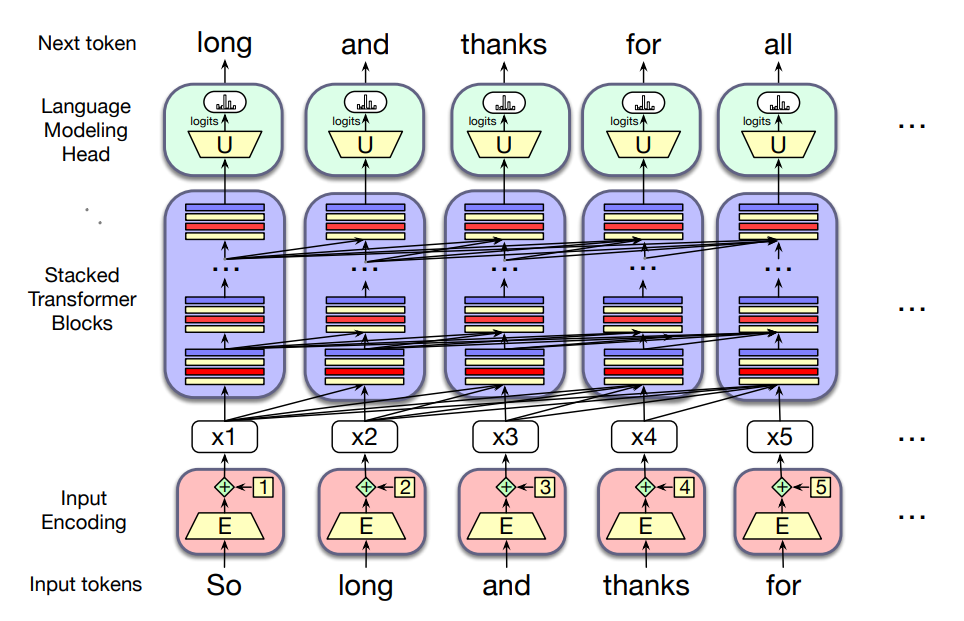
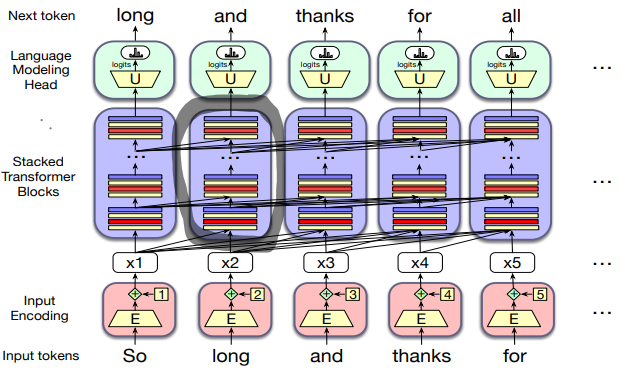
- This figure sketches the transformer architecture
- Three major components
- At the center there are columns of transformer block, each one is a multilayer network (a multi-head attention layer, a feedforward network and a layer normalization steps) that maps an input vector
in column (corresponding to input token to an output vector ). - The set of
blocks maps an entire context window of input vectors to a window of output vector of the same length. - Input encoding component: processes an input token (like the word thanks) into a contextual vector representation using an embedding matrix
and a mechanism for encoding token position. - Each column is followed by a language modeling head, which takes the embedding output by the final transformer block, passess it through an unembedding matrix
and a softmax over the vocabulary to generate a single token for that column.
Attention
Contextual Embeddings
Let’s consider the embeddings for an individual word from a particular layer.
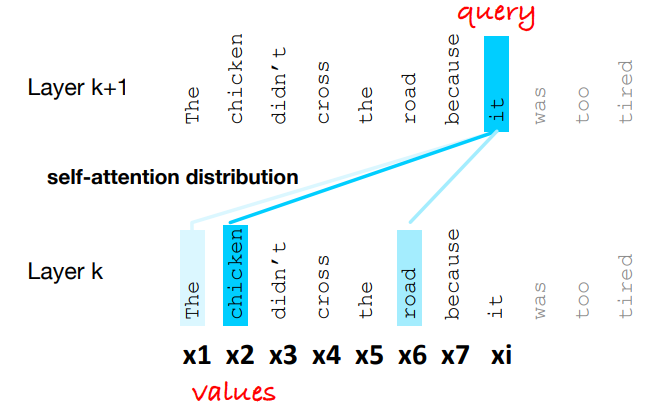
Example: The chicken didn’t cross the road because it was too tired.
What is the meaning represented in the static embedding for “it”?
Intuition: a representation of the meaning of a word should be different in different contexts.
In contextual embedding, each word has a different vector that expresses different meanings depending on the surrounding words.
To compute contextual embeddings, attention is used.
In the sentence: “The chicken didn’t cross the roat because it…” What should be the properties of “it”?
- The chicken didn’t cross the road because it was too tired
- The chicken didn’t cross the road because it was too wide
In the first sentence, the reader knows that it’s the chicken that it’s tired, and in the second, it’s the road that it’s wide. But a casual language model with a left-to-right architecture wouldn’t necessary understand this.
Overview of attention
Attention builds up the contextual embedding form a word by selectively integrating information from all the neighbouring words.
A word “attends to” some neighbouring words more than others.
Attention is formally defined as: the mechanism in the transformer that weighs and combines the representations from appropriate other tokens in the context from layer
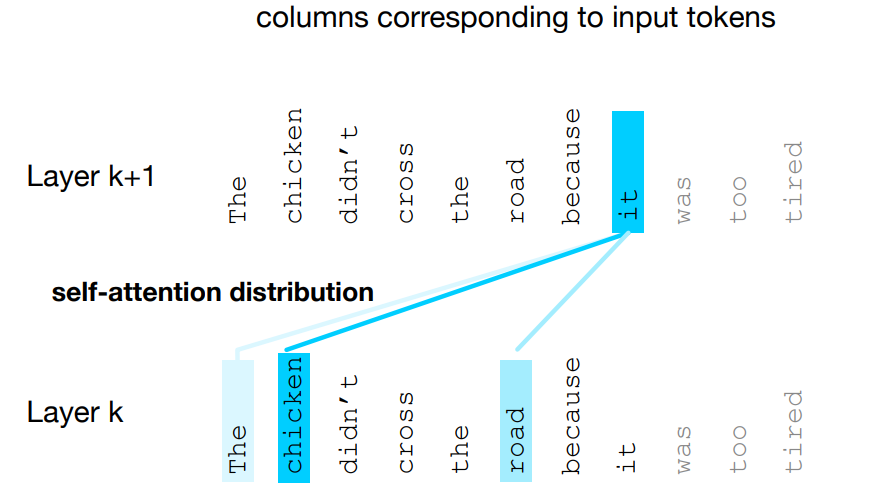
- Figure shows the self-attention weight distribution
that is part of the computation of representation for the word it at layer - In computing the representation for it, we attend differently to the various words at layer k, with darker shades indicating higher self-attention values.
Simplified Attention
Input:
- representation
corresponding to the input token at position , - context window of prior inputs
and produces an output
Information flow in casual self-attention: it is left-to-right, this means that the context is any of the prior words.
When processing
Seeing tokens after
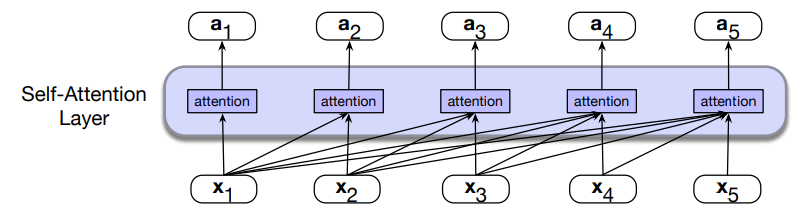
Ofcourse, the same attention computation happens in parallel at each token position
A self-attention layer maps input sequences
Simplified version of attention: consider first a simplified intuitive version of attention, in which the attention output
In attention we weight each prior embedding proportionally to how similar is it to the current token
The larger the score, the more similar the vectors that are being compared. Then the scores must be normalized with a softmax to create the vector of weights
and
Intuition of Attention: so we compute
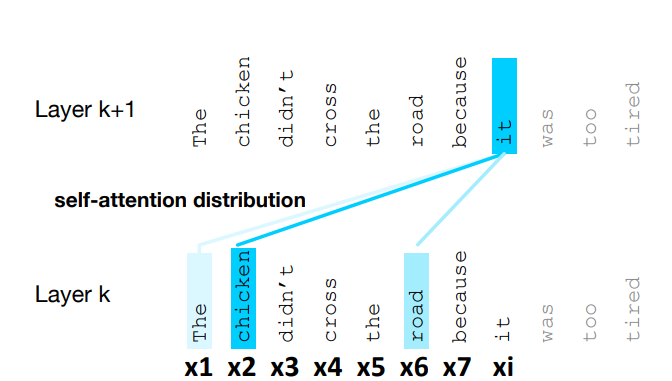
Attention Head
Head in transformers is used to refer to specific structured layers
instead of using vectors like (
- Query: when the vector is the current element being compared to the preceding inputs
- Key: the vector is the preceding input that is compared to the current element to determine a similarity
- Value: the value of a preceding element that gets weighted and summed up to compute the output for the current element
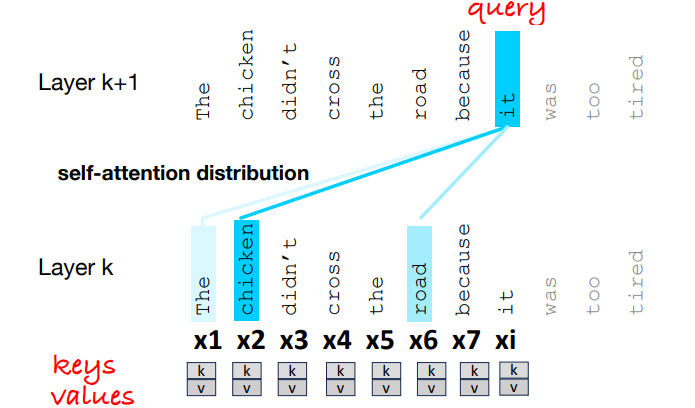
To capture these three different roles, transformers introduce weight matrices:
- query:
- key:
- value:
These weights will projct each input vector
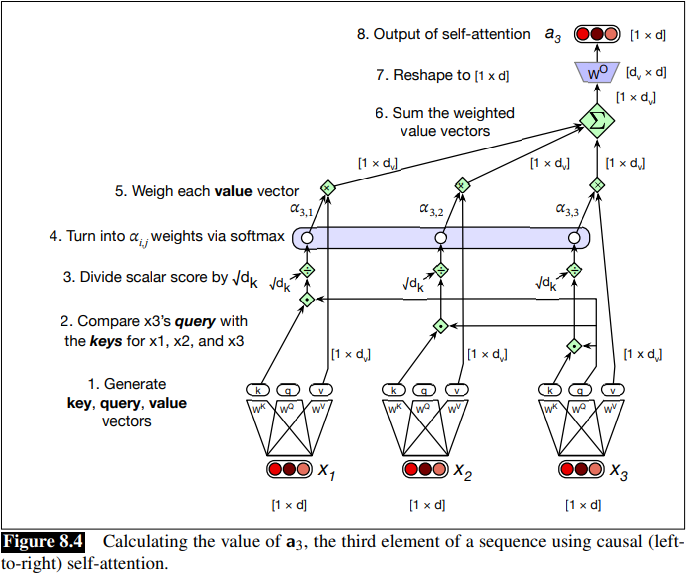
Given the three representation of
- It is considered the dot product between the current element’s query vector
and the preceding element’s key vector
Attention weight, score and output:
The attention weight
Another issue, is that the dot product can be a arbitrarily large (positive or negative) value, and exponentiating large values can lead to numerical issues and loss of gradients during training, so it is normalized by the square root of
Softmax calculation resulting in
Final set of equations for computing self-attention for a single self-attention output vector
Model Dimensionality and why the matrix
This is more or less the chain:
are both so it becomes a scalar is the dimension for value vectors choosen arbitrarily (i.e in original paper 64) and is the dimension of value vectors. and has shape , while is - The output head has shape
. - TO get the desired output shape
], a matrix is of shape ]
On the Value Role:
We don’t use the raw token embeddings
- Different attention heads need different transformed information from each token, not just the original embedding
- The model learns which aspects of a token should be “copied forward” once attention decides it is important
- Values allow separation between how strongly we attend to a token
and what information we take from it .
Multi-head Attention
Idea: instead of one attention head, we ‘ll have a lot of them.
Example: suppose the sentence is “The bank raises interest rate”, different attention heads may want:
- syntactic info (noun: subject)
- semantic info (bank: financial institution)
- contextualized info (economic topic)
Using
Intuition: each head might be attending to the context for different purposes, some may specialized to represent different linguistic relationships between context elements and the current token, or to look for particular kinds of pattern in the context.
Multi-head attention: we have a number of
Each head
Model dimensionality of multi-head:
Equations for attention augmented with multiple heads:
- MultiHeadAttention(
) =
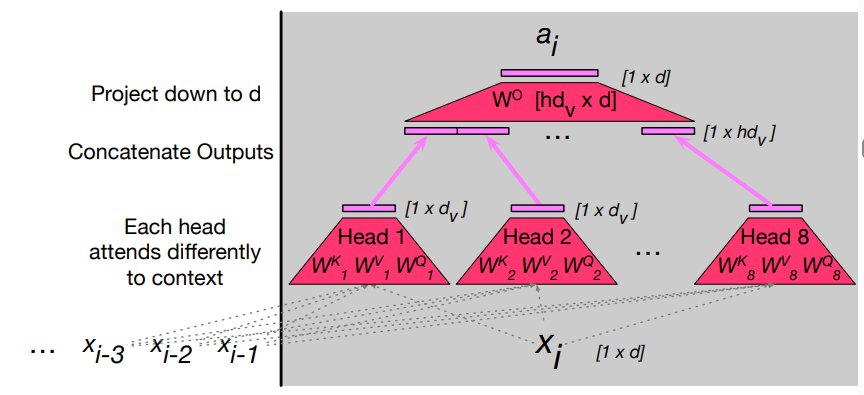
The output of each of the
The Transformer Block
The self-attention calculation lies at the core of what’s called a transformer block, which, in addition to the self-attention layer, includes three other kinds of layers:
- a feedforward layer,
- residual connections,
- normalizing layers (colloquially called “layer norm”)
A common way of thinking about the block: the residual stream i.e each token gets passed up and modified.
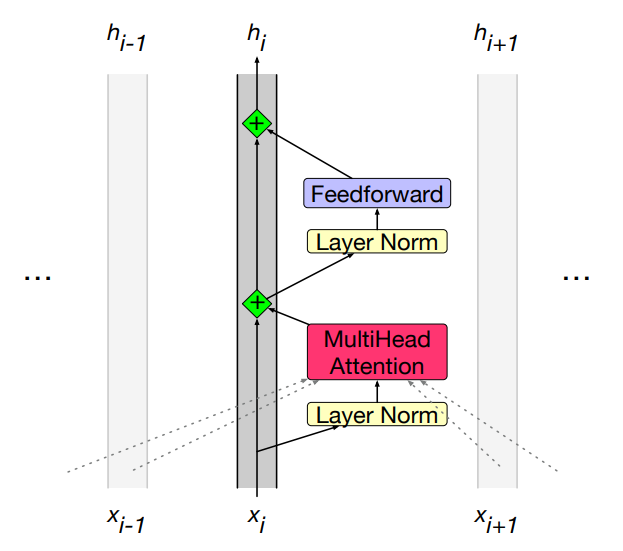
- Figure shows the residual stream: the prenorm version of the architecture, in which the layer norms happen before the attention and feedforward layers rather than after.
Feedforward layer: The feed-forward layer is a fully-connected 2-layer neural network with one hidden layer and two weight matrices. It provides us with the needed nonlinearities:
While attention mixes information across tokens, FFN operates independently on each token:
- Refines each token representation individually
- Helps the model encode local features and non-contextual properties
- Stabilises token embeddings after attention mixing
This allows the transformer to approximate more complex functions and decision boundaries.
Overall
- Attention tells the model what to look at
- The FFN tells the model how to transform what it found
Layer Norm
The layer norm is a variation of
Then the vector components are normalized by subtracting the mean from each and dividing by the standard deviation:
Finally, two learnable parameters
Putting together a single transformer block
The function computed by a transformer block can be expressed by breaking it down with one equation for each component computation, using 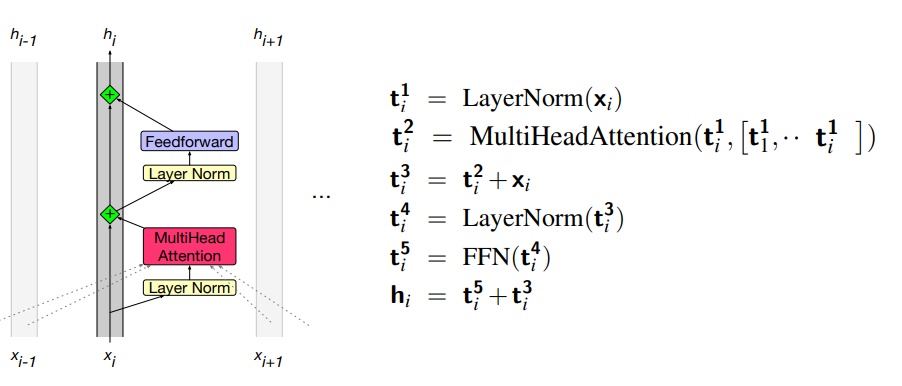
Stack of blocks: a transformer is a stack of these components. All vectors are of the same dimensionality
One more requirement: at the very end of the last (highest) transformer block, there is a single extra layer norm that is run on the last
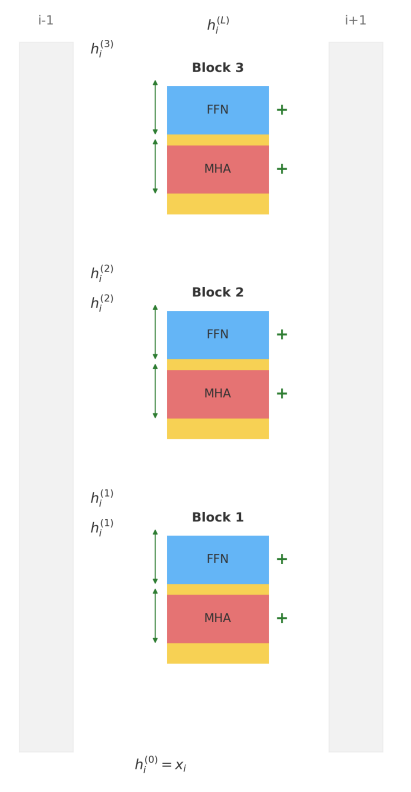
Residual Streams Attention heads can be seen as moving information from the residual stream of a neighboring token into the current stream.
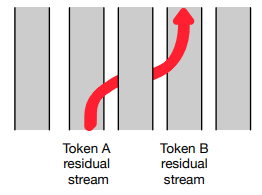
Notice that the only component that takes as input information from other tokens
(other residual streams) is multi-head attention, which (as we see from
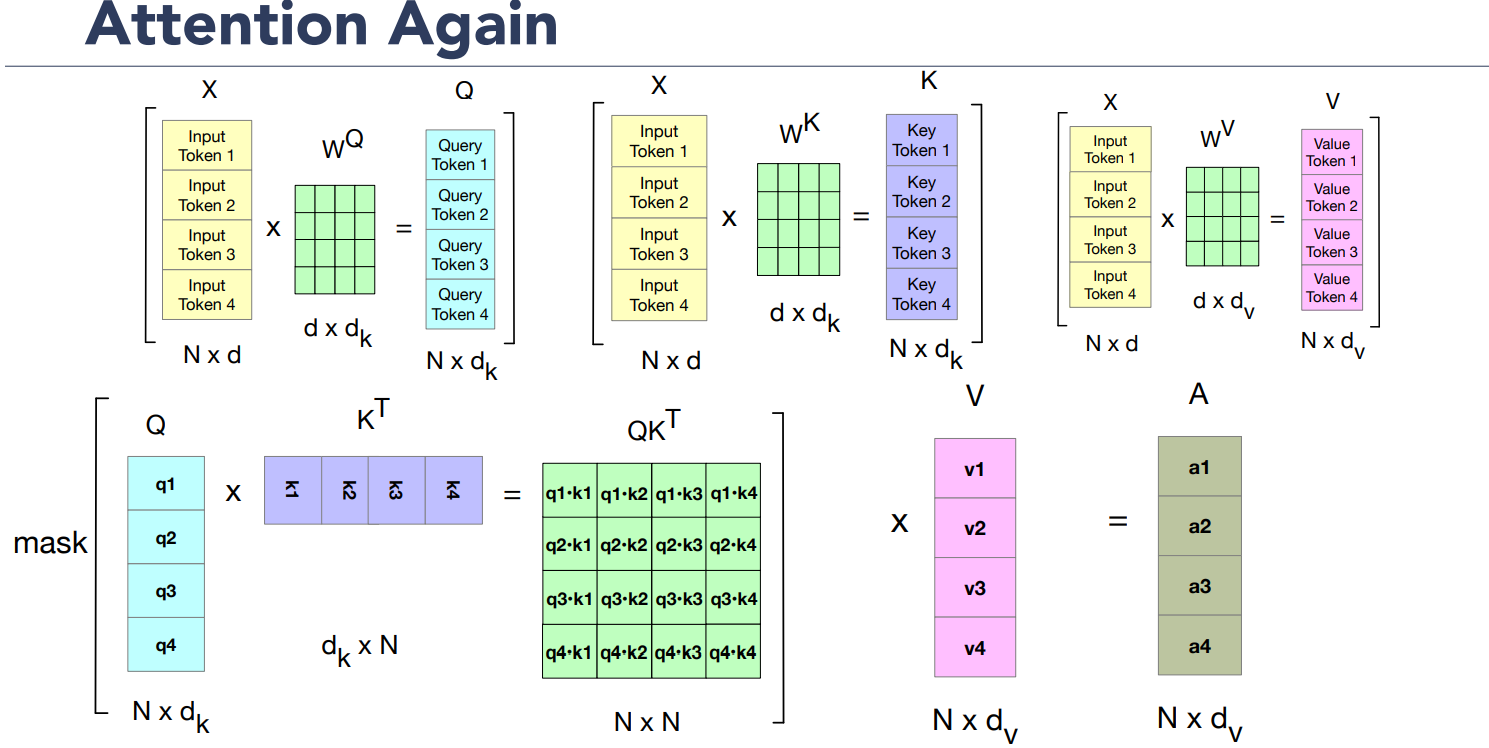
Parallelizing Attention
The attention computation performed for each token to compute
But we can pack the input embeddings for the
Parallelizing Attention - Single Head Attention. For one head we multiply
We can compute all the requisite query-key comparisons simultaneously by multiplying 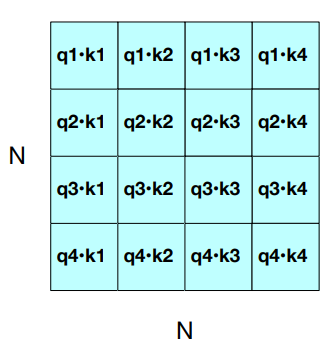
Once we have the
Masking out the future
We introduced a mask function, because the self-attention has a problem: it cheats by looking at the future and including key-value that follows the token in the query.
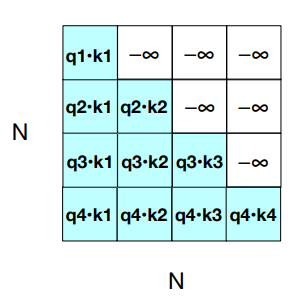 Guessing the next word is simple if you already know it.
Solution: add
Guessing the next word is simple if you already know it.
Solution: add
Observation: attention is quadratic in lenght.
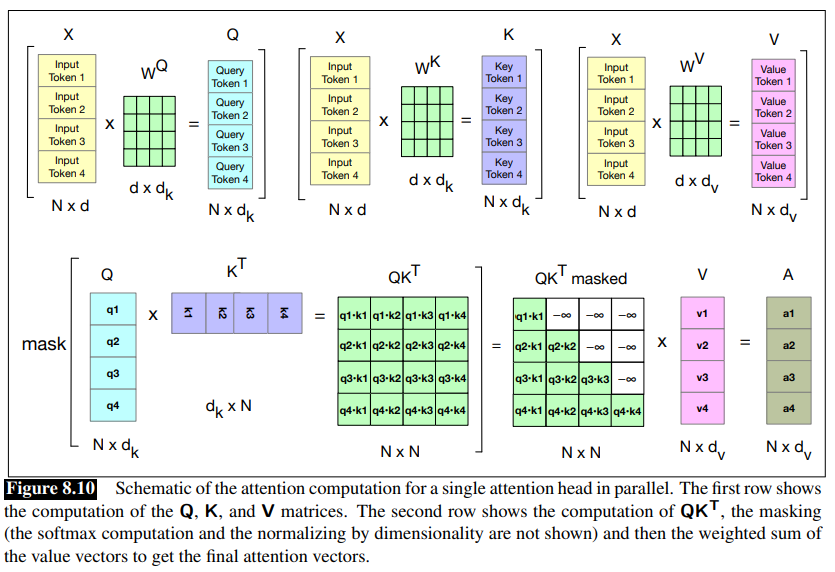
Parallelizing Multi-Head Attention The model has:
- a dimension
- query and embeddings have dimensionality
- value embeddings are of dimesionality
For each head
of shape of shape - and
of shape
These get multiplied by the inputs packed into
of shape ], of shape - and
of shape .
The output of each of the
Putting it all together with the parallel input matrix
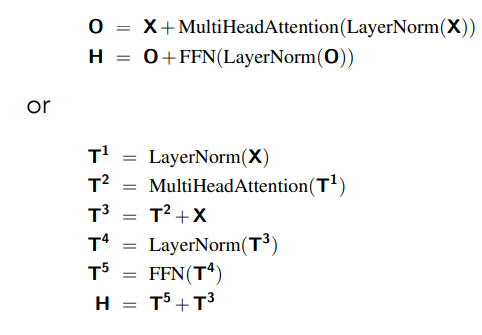
- by
we mean the input to the layer, wherever it comes from. For subsequent layers , the input is the output of the previous layer . - In the second part of equations, the computation performed by a transformer layer are breakd down, showing one equation for each component.
stands for transformer and superscripts denote each computation inside the block.
Input: embeddings for token and position
Given a sequence of
The set of initial embeddings are stored in the embedding matrix
- One row for each of the
tokens in the vocabulary - Each word is a row vector of dimension
Example: Given an input string ”Thanks for all the“:
- Convert the tokens into vocabulary indices (created when we first tokenized the input using BPE or SentencePiece), so the representation might be
- Select the corresponding rows from
, each row an embedding: (row 5, row 4000, row 10532, row 2224)
Another way to think about selecting token embeddings from the embedding matrix is to represent tokens as one-hot vectors of shape
Recall that in a one-hot vector all the elements are 0 except one, the element whose dimension is the word’s index in the vocabulary, which has value 1.
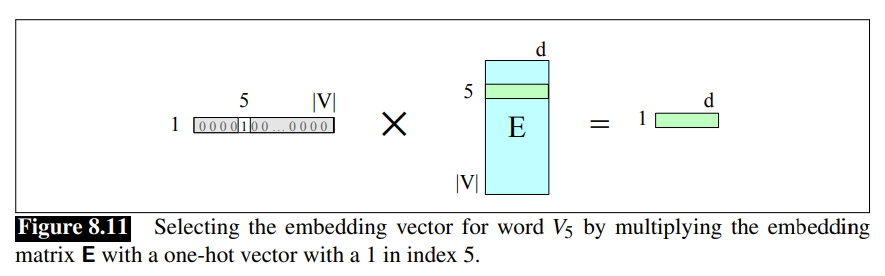
This can be extended to represent the entire token sequence as a matrix of one-hot vectors, one for each of the 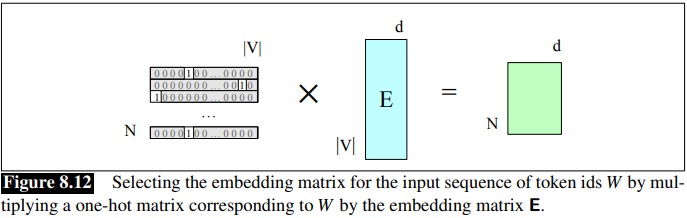
Positional Embedding
These token embeddings are not position-dependent. To represent the position of each token in the sequence, we combine these token in embeddings with positional embeddings specific to each position in an input sequence.
Transformers process text as a sequence of tokens. However, unlike RNNs, they do not inherently know the order of tokens.
To fix this, they add positional information to each token’srepresentation, therefore
- Token embedding tells the model what a word is (e.g., “fish”).
- Positional embedding tells the model where the word is located in the sentence (e.g., 3rd position, 17th position, etc.)
To represent the position of each token in the sequence: combine token embeddings with positional embeddings specific to each position in an input sequence.
There are many methods, but we’ll just describe the simplest: absolute position, shown in the figure:
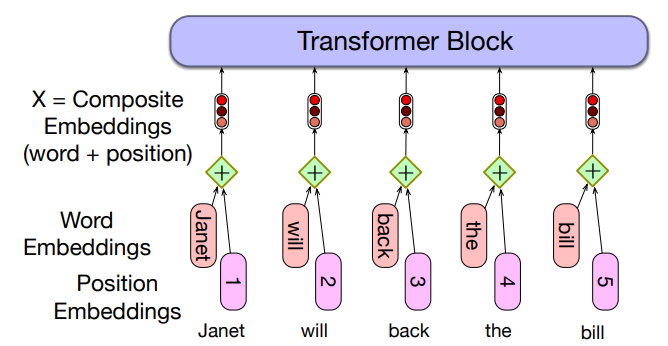
Start with randomly initialized embeddings
- one for each integer up to some maximum length
- i.e., just as we have an embedding for token fish, we’ll have an embedding for position 3 and position 17
As with word embeddings, these positional embeddings are learned along with other parameters during training. Then they are stored in a embedding matrix
The final representation of the input, the matrix
Absolute Positional Embedding Issues:
In absolute positional embedding, we treat positions like a vocabulary of words. We define a maximum sequence length and for every integer we learn a unique vector
These embeddings are learned during training, just like word embeddings. For instance, if the model is trained with
Another issue is with data, during training most sentences are short:
- So early positions (like
) appear very often, but positions near the maximum length appear rarely - Embeddings for long positions may be low quality and may not generalize.
Alternatives Positional Encodings
In the original transformer work, a static function as a combination of sine and cosine functions with different frequencies is used.
Sinusoidal position embeddings may also help in capturing the inherent relationships among the positions, the fact that position
Another option is to represent relative position instead of directly absolute position. Often implemented in the attention mechanism at each layer, rather than being added once at the initial input.
Output: The Language Modelling Head
(Language Model) Head means the additional neural circuitry that is added on top of the basic transformer architecture when we apply pretrained transformer model to various tasks.
Recall NLP - Lecture - Language Models, N-Grams, Perplexity and how they work. A language models allow, given a context of words (context window) to assign a probability to each possible next word.
Transformers context is represented through a a context window, which can be quite large, like 32K tokens for large models.
The job of the language modeling head is to take the output of the final transformer layer from the last token N and use it to predict the upcoming word at position N +1.
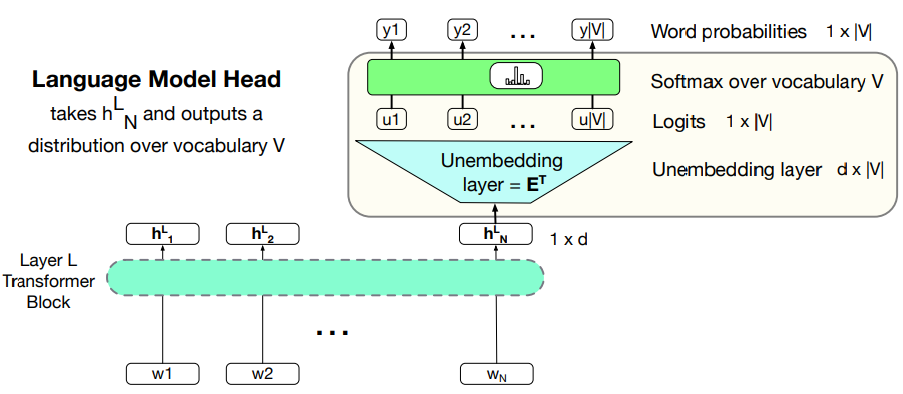
- The circuit at the top of a transformer that maps from the output embedding for token
from the last transformer layer to a probability distribution over words in the vocabulary .
Unembedding layer: linear layer projects from
Recall that in weight tying we use the same weight for two different matrices.
Unmbedding layer takes the embedding matrix of shape
A softmax layer turns the logit into probabilities over the vocabulary
We can use these probabilities to do things like help assign a probability to a given text, but the most important usage is to generate text, which we do by sampling a word from these probabilities
The Final Transformer Model:
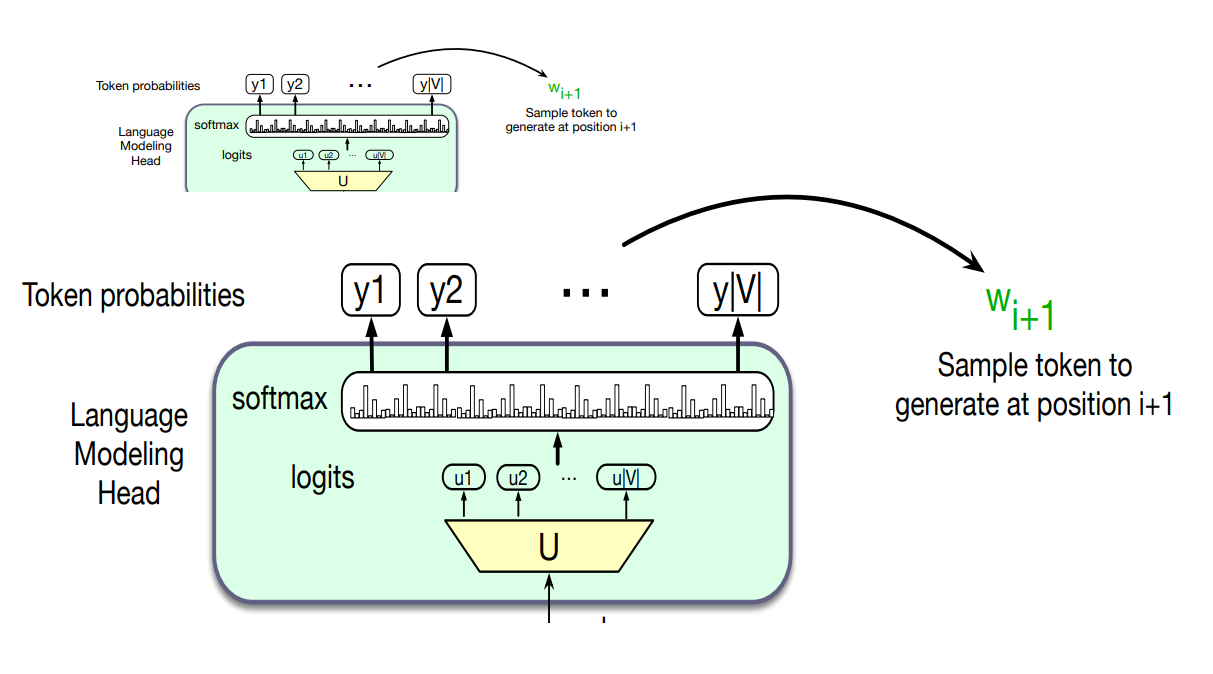
The entire stacked architecture for one token
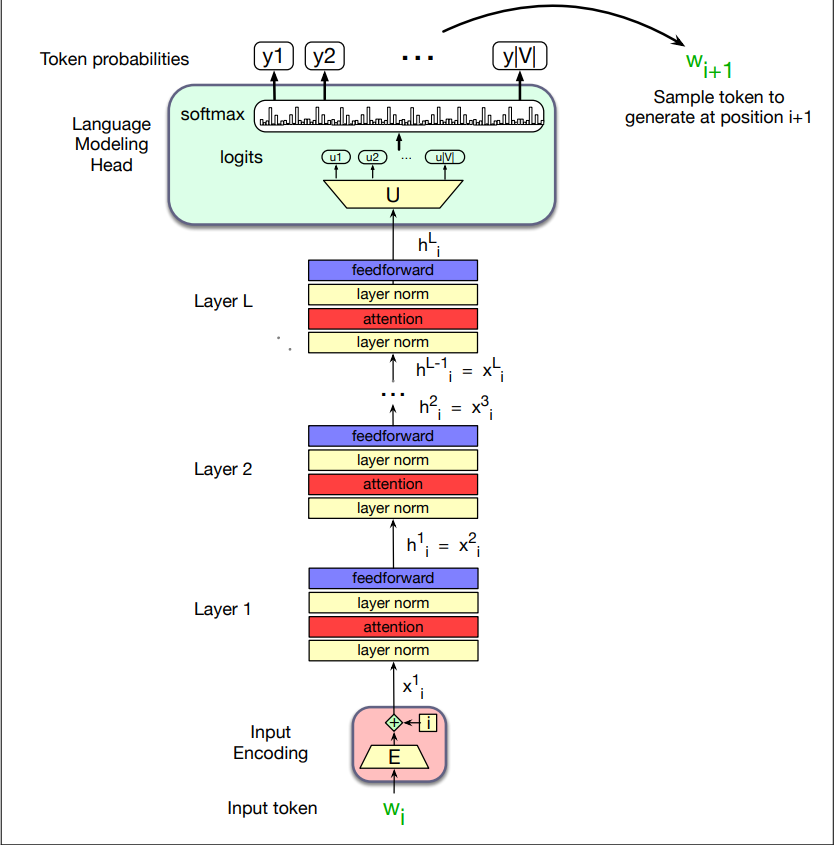
- Note that the input to each transformer layer
is the same as the output from the preceding layer .
Training the Transformer
At each step, given all the preceding words, the final transformer layer produces an output distribution over the entire vocabulary.
During training, the probability assigned to the correct word by the model is used to calculate the cross-entropy loss for each item in the sequence.
Large Language Models are trained with cross-entropy loss also called negative log likelihood loss i.e
The weights in the network are adjusted to minimize the average CE loss over the training sequence via gradient descent.
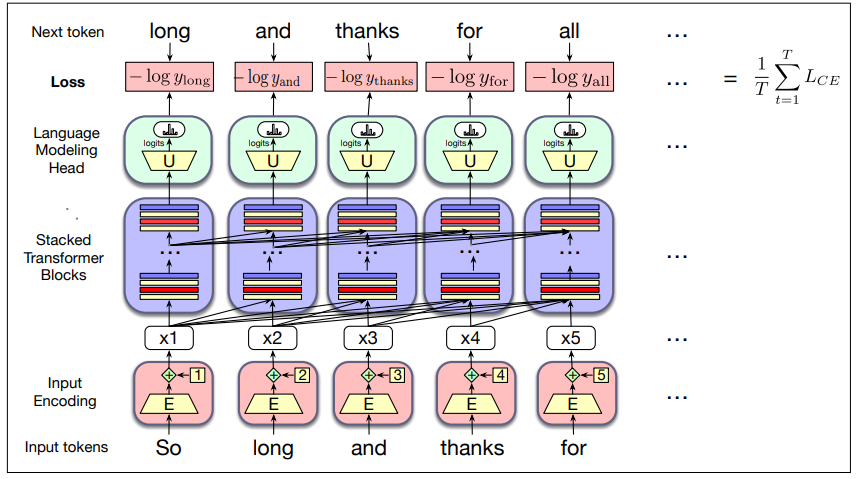
With transformers, each training item can be processed in parallel since the output for each element in the sequence is computed separately (as saw in previous section on parallelization).
Modern LLMs like GPT-4 and LLama 3 have a maximum context window (amount of text they can ingest at once):
- GPT4: 4096 tokens
- Llama 3: 8192 tokens
To maximize training efficiency, we fill this entire window with text for every training example.
If documents are shorter than this, multiple documents are packed into the window with a special end-of-text token between them.
During training, many sequences fit into a single batch:
- Because each sequence is so large (thousands of tokens), the batch size is measured in tokens, not documents
- The batch size for gradient descent is usually quite large (the largest GPT-3 model uses a batch size of 3.2 million tokens)
A transformer used for this kind of unidirectional causal language model is called a decoder only model.
This is because this model constitutes roughly half of the encoder-decoder model for transformers.
Dealing With scale
Llama 3.1 405B instruct model from Meta has 405 billion parameters (
So there is a lot of research on understanding how LLMs scale, and especially how to implement them given limited resources.
Scaling Laws
Performance of LLM depends on 3 factors:
- model size: the number of parameters not counting embedding
- data size: the amount of training data
- amount of compute used for training
A model can be improved by adding parameters (adding more layers or having wider contexts or both), training more data or by training for more iterations.
The relationships between these factors and performance are known as scaling laws.
Roughly speaking, the performance of a large language model (the loss) scales as a power-law with each of these three properties of model training.
Kaplan et al found the following three relationships for loss
The number of (non-embedding) parameters
is the input and output dimensionality of the model is the self-attention layer size is the size of the feedforward layer - assuming
Thus GPT-3, with
The values depend on the exact transformer architecture, tokenization, and vocabulary size.
Scaling laws can be useful in deciding how to train a model to a particular performance, for example by looking at early in the training curve, or performance with smaller amounts of data, to predict what the loss would be if we were to add more data or increase model size. Other aspects of scaling laws can also tell us how much data we need to add when scaling up a model.
KV Cache
We saw that the attention vector can be very efficiently computed in parallel for training, via two matrix multiplication:
Unfortunately we can’t do quite the same efficient computation in inference as in training.
At inference time, we iteratively generate the next tokens one at a time.0
For a new token that we have just generated, call it
But it would be a waste of computation time to recompute the key and value vectors for all the prior tokens
So instead of recomputing these, whenever we compute the key and value vectors we store them in memory and in the KV cache, and then we can just grab them from the cache when we need them.
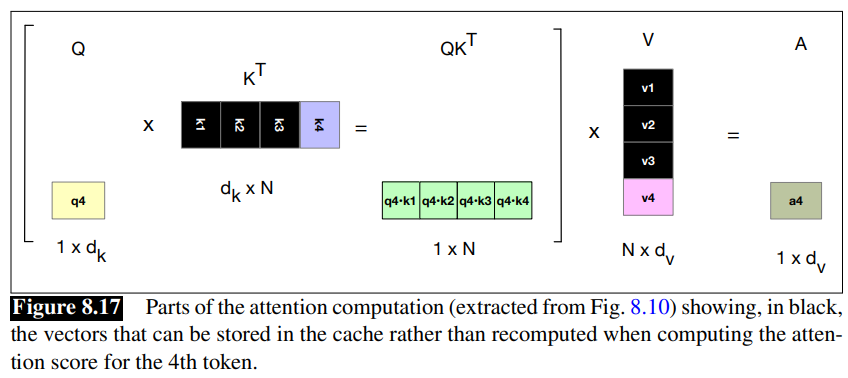
Fig 8.10:
Parameter Efficient Fine Tuning
It’s very common to take a language model and give it more information about a new domain by finetuing it (continuing to train it to predict upcoming words) on some additional data.
Fine-tuning can be very difficult with very large language models, because there are enormous numbers of parameters to train; each pass of batch gradient descent has to backpropagate through many many huge layers.
There are alternative methods that allow a model to be finetuned without chaing all the parameters. Such methods are called parameter-efficient fine tuning or sometime PEFT.
A subset of parameters to update when finetuning are selected (see feature selection).
Here we describe one such model called LoRA: Low-Rank Adaption
LoRA
The intuition of LoRA is that transformers have many dense layers which perform matrix multiplication (for example the
Instead of updating these layers during finetuning, with LoRA we freeze these layers and instead update a low-rank approximation that has fewer parameters.
Consider a matrix
In LoRA, we freeze
During finetuing we update 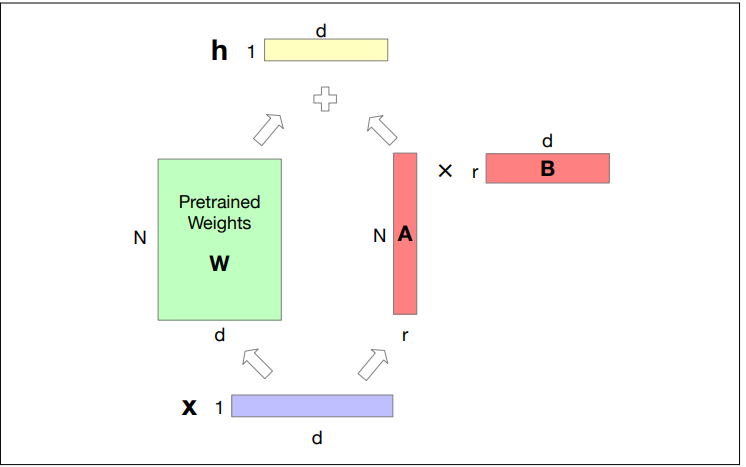
For replacing the forward pass
LoRA advantages:
- It dramatically reduces hardware requirements since gradients don’t have to be calculated for most parameters.
- The weights updates can be simply added in to the pretrained weights, since
is of the same size as - It’s possible to build LoRA modules for different domains and just swap them in and out by adding them in or subtractng them from
Interpreting the Transformer
The subfield of interpretability, sometimes called mechanistic interpretability, focuses on ways to understand mechanistically what is going on inside the transformer.
In-Context Learning and Induction Heads
As a way of getting a model to do what we want, we can think of prompting as being fundamentally different than pretraining.
Prompting with demonstrations can teach a model to do a new task. The model is learning something about the task from those demonstrations as it processes the prompt. (See [[NLP - Lecture - Large Language Models (LLM)|[NLP] LLM]]).
For example, the further a model gets in a prompt, the better it tends to get at predicting the upcoming tokens. The information in the context is helping give the model more predictive power.
The term in-context learning was first proposed by Brown et al. (202) in their introduction of the GPT3 system, to refer to either of these kinds of learning that language models do from their prompts.
In-context learning means language models learning to do new tasks, better predict tokens, or generally reduce their loss during the forward-pass at inference-time, without any gradient-based updates to the model’s parameters.
We don’t know for sure how in-context learning work.
One hypothesis is based on the idea of induction heads: are the name for a circuit which is a kind of abstract component of a network.
The induction head circuit is part of the attention computation in transformers, discovered by looking at mini-language models with only 1-2 attention heads.
The function of the induction head is to predict repeated sequences.
For example if it see the pattern
It does this by having a prefix matching component of the attention computation that, when looking at the current token
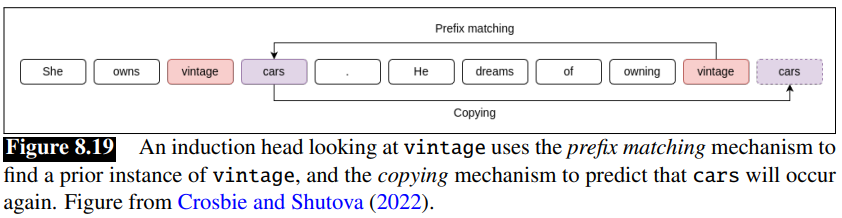
Olsson et al (2022) propose that a generalized fuzzy version of this pattern compeltion rule, implementing a rule like
Evidence for their hypothesis come from Crosbie and Shutova (2022) who show that ablating induction heads causes in-context learning performance to decrease. Ablation is a medical term that means removal of something. They find induction heads by first finding attention heads that perform as induction heads on random input sequences, and then zeroing out the output of these heads by setting certain terms of the output matrix
Logit Lens
Another useful tool called logit lens (Nostalgebraist, 2020) offers a way to visualize what the internal layer of the transformer might be representing.
The idea is that we take any vector from any layer of the transform and, pretending that it is the prefinal embedding, simply multiply it by the unembedding layer to get logis, and compute a softmax to see the distribution over words that vector might be representing.
Since the network wasn’t trained to make the internal representations function in this way, the logit lens doesn’t always work perfectly.